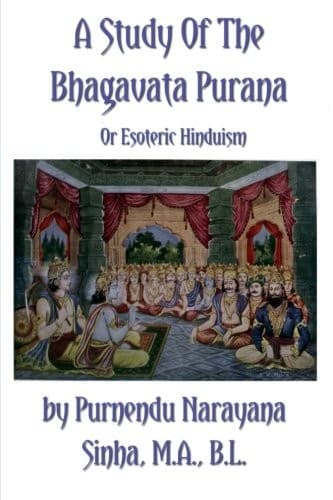
A Study of the Bhâgavata Purâna; or, Esoteric Hinduism
Religion
A Study of the Bhâgavata Purâna; or, Esoteric Hinduism
Puranas. Bhagavatapurana. English
Once upon a time Râhugana King of Sindhu and Saubira was travelling in a
palanquin. The chief palanquin bearer on reaching the river Ikshumati
went in search of a bearer and on finding Bharata deemed him to be a
god-send. He found his limbs strong and well-built and thought him
capable of bearing the palanquin. He forced Bharata into the service.
Bharata though quite unfit for this menial work did his utmost. But he
was in the habit of looking forward for the distance of an arrow throw
and then taking steps in advance, so that he might not unwarily kill
some animal under his feet. He could not therefore keep pace with the
other bearers and the palanquin lost its balance. King Rahûgana became
angry and reproached the bearers. They complained against the new
recruit. The king taunted Bharata with these words; "Oh my friend I dare
say you are tired — for have you not carried me long and for a long
distance too — and you appear to be thin indeed and weak. Are you
suffering from decrepitude? Are not these your fellow-mates."
Bharata kept quiet. For these taunting remarks did not touch him. He was
crystallised in wisdom and was no longer troubled with the false
perceptions of "I and mine."
The palanquin again lost its balance. The king lost his temper and broke
forth thus; "What is this? are you alive or dead? Do you thus disregard
my orders and think of living? You must be a madman, like the Death-god
I will punish your madness and bring you to your senses." King Rahûgana
was proud of his learning and his kingship. He was inflated with Rajas
and Tames. He had therefore no hesitation in reproaching that lord of
Yoga, Bharata.
Bharata smiled and thus replied: — "Thy taunts are true, O king! There
is no doubt, I am neither tired nor did I travel long. For thy weight
does not affect me nor have I any distance to travel. Nor could I be
called fat. For the body is fat and not I. It is by falsely attributing
the bodily attributes to self that one is said to have thickness,
leanness, disease, hunger thirst, fear, enmity, desire, sleep,
attachment, anger, egotism, pride and sorrow. But I have no such false
perception.
"Thou sayest I am dead even when alive. But such is the case with all
beings for they are all subject to constant transformations.
"Thou chargest me with disregarding the orders of my Master. But only if
the relationship of Master and servant does really subsist, might there
be command and obedience. But where is that relationship? If thou
sayest, in the ways of the world, thou art my king momentary though
these ways be, please tell me thy behests.
"Thou callest me a mad man and dost want to punish me and bring me to my
senses. But I am not mad, though I may look so, for I am fixed in the
meditation of Brahmâ. But still if thou thinkest me to be a madman it
will be useless to punish or to teach a senseless being."
Public-domain text, read in full here on John Shaqi.
Reviews
Reviews
No reviews yet
Be the first to share your thoughts on this work.
Elsewhere in the archive
Join the Discussion
Join the discussion
Sign in to leave a comment or review.
Sign InorCreate an account