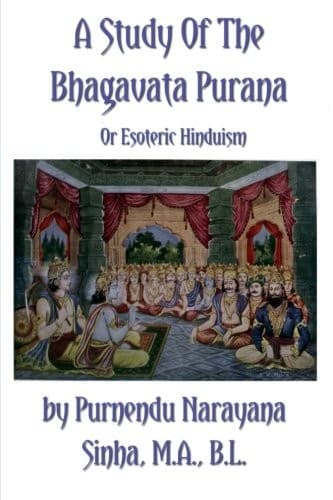
A Study of the Bhâgavata Purâna; or, Esoteric Hinduism
Religion
A Study of the Bhâgavata Purâna; or, Esoteric Hinduism
Puranas. Bhagavatapurana. English
When these fruits drop down, they give out a very sweet, very fragrant,
profuse reddish juice which collects to form the river called Arunodâ,
having water of the color of Aruna or the morning Sun. This river waters
the Eastern part of Ilâvrita. The use of its water gives such a sweet
scent to the body of the female attendants of Durgâ that the wind
carries that scent to ten Yojanas around.
So the Jambu river is formed by the juice of the fruits that drop down
from the Jambolova tree in Meru Mandâra. It waters the southern part of
Ilâvrita.
The land on the banks of these rivers is soaked by their juice and
worked on by air and light and is thus converted into gold called
Jâmbûnada, which gives ornaments to the Devas.
Aruna is the morning Sun, as well as the color of the morning Sun. The
river with Aruna water is also gold producing.
The Kadamba tree on Supârsva has cavities from which flow five streams
of honey, each 5 Vyâmas wide (Vyâma = the space between the tips of the
fingers of either hand when the arms are extended.) These streams water
the western part of Ilâvrita. The fragrant breath of those that use them
spreads over one hundred Yojanas all round.
The fig tree (Vata) called Satavolsa on the summit of Kumuda has
branches which give rise to rivers that bring forth milk, curd, honey,
clarified butter, molasses, edibles, carpets, cloths, ornaments, in fact
all objects of desire. These rivers fall from Kumuda and water the
northern part of Ilâvrita.
Those that use the waters of those rivers are free from all Infirmities,
diseases, secretions, old age and death. They live in absolute bliss all
their lives.
There are twenty more mountains on all sides of Meru, at its foot. They
are Kuranga, Kurara, Kusumbha Naikovka, Trikuta, Sisira, Patanga.
Ruchoka, Nishadha Sitivâsa, Kapila Sankha, Vaidûrya, Jârudhi, Housas,
Rishabha, Nâga, Kâlanjara, Nirada and others.
Two mountains, Jatharu and Devakûta, are situated on the east of Meru.
They are two thousand Yojanas in height and in width. To the north they
spread over 18,000 Yojanas.
So on the west there are the two mountains Pavana and Pâriyâtra.
On the south there are Kailâśa and Karavira, which expand towards the
east. So on the north, there are Trisringa and Makara. (If different
measures are given in Vishnu and other Purânas, they are with reference
to different Kalpas. _Śridhara_).
The sages say that in the central portion of the top of Sumeru is the
abode of Brahmâ, made of gold, 10,000,000 Yojanas in area, and of four
equal sides.
Surrounding the abode of Brahmâ are the eight abodes of the eight
Lokapâlas situated respectively in the directions presided over by these
Lokapâlas. Each of these abodes has the color of its own Lokapâla and
each extends over 2 1/2 thousand yojanas. (The names of these abodes are
given in other Purânas. Thus:
Public-domain text, read in full here on John Shaqi.
Reviews
Reviews
No reviews yet
Be the first to share your thoughts on this work.
Elsewhere in the archive
Join the Discussion
Join the discussion
Sign in to leave a comment or review.
Sign InorCreate an account