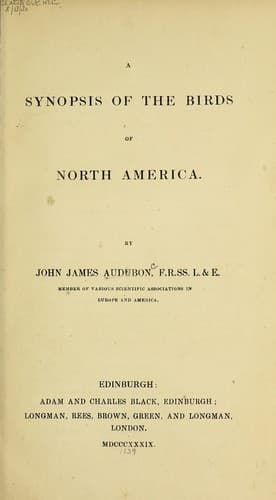
A Synopsis of the Birds of North AmericaAudubon, John James
Science
A Synopsis of the Birds of North America
Audubon, John James
Birds -- Classification; Birds -- North America
Bill short, robust, bulging at the base, conical, acute; upper
mandible of the same breadth as the lower, with its dorsal line very
convex, the nasal sinus semicircular, the sides convex, the edges
sharp, overlapping, gently ascending at the base, then arched, with a
slight festoon, the notches obsolete, the tip declinate, acute; lower
mandible with the angle semicircular, the dorsal line slightly convex,
the back rounded at the base, the sides convex, the edges somewhat
inflected, the tip obtuse. Nostrils basal, round, concealed by bristly
feathers. Head large, roundish-ovate; neck short; body moderately
stout; feet short; tarsus short, compressed, with seven scutella; toes
stout, the first proportionally large, the lateral nearly equal, the
outer adherent at the base. Claws long, moderately arched,
compressed, acute, that of the third toe longer than that of the
first. Plumage soft, full, rather blended; two tufts of bristly
feathers at the base of the upper mandible directed forwards. Wings of
moderate length, pointed, the first, second, and third, nearly equal.
Tail rather long, deeply emarginate. Roof of the mouth concave, with
five prominent ridges; tongue deeper than broad, in its distal half
oblong, concave, obtuse, and horny; œsophagus dilated about the
middle; stomach large, muscular, with the lateral muscles distinct,
and the epithelium rugous, intestine long, and rather slender; cœca
very small; cloaca oblong.
199. 1. Corythus Enucleator, Linn. Common Pine-finch.--Pine Grosbeak.
Plate CCCLVIII. Male, Female, and Young.
Male bright carmine, tinged with vermilion; the feathers on the fore
part of the back and the scapulars greyish-brown in the centre;
bristly feathers at the base of the bill blackish-brown; middle of the
breast, abdomen, and lower tail-coverts, light grey, the latter with a
central dusky streak; wings blackish-brown; primaries edged with
reddish-white, secondaries more broadly with white; secondary coverts
and first row of small coverts tipped with reddish-white; smaller
coverts edged with red. Female with the upper part of the head and
hind neck yellowish-brown, the rump brownish-yellow, the rest of the
upper parts light brownish-grey, wings and tail as in the male, but
the white edgings and tips tinged with grey; cheeks and throat
greyish-white, or yellowish; lower parts ash-grey, anteriorly tinged
with brownish-yellow. The young resemble the female. Young males
yellow and red, like those of Loxia curvirostra.
_Male_, 8-1/2, 14. _Female_, 8-1/4, 13-1/2.
From Pennsylvania and New Jersey, in winter, eastward to Newfoundland.
Breeds from Maine northward. Common. Migratory.
Pine Grosbeak, Loxia Enucleator, Wils. Amer. Orn. v. i. p. 80.
Pyrrhula Enucleator, Bonap. Syn. p. 119.
Pyrrhula (Corythus) Enucleator, Pine Bullfinch, Swains. &
Rich. F. Bor. Amer. v. ii. p. 262.
Pine Grosbeak or Bullfinch, Nutt. Man. v. i. p. 535.
Public-domain text, read in full here on John Shaqi.
Reviews
Reviews
No reviews yet
Be the first to share your thoughts on this work.
Elsewhere in the archive
Join the Discussion
Join the discussion
Sign in to leave a comment or review.
Sign InorCreate an account