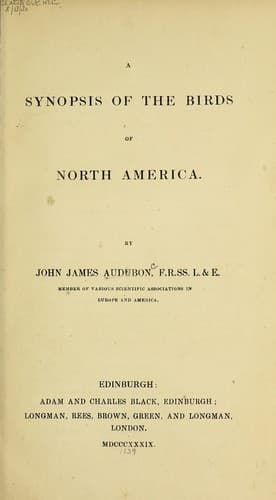
A Synopsis of the Birds of North AmericaAudubon, John James
Science
A Synopsis of the Birds of North America
Audubon, John James
Birds -- Classification; Birds -- North America
Bill excessively compressed, with the mandibles less curved. Male rich
carmine, inclining to crimson; the feathers on the fore part and
middle of the back dusky, excepting the tips; the scapulars, wings,
upper tail-coverts, and tail black; two broad bands of white on the
wings, the anterior formed by the first row of small coverts, and
several of those adjoining, the other by the secondary coverts, of
which the basal half only is black. Female with the feathers of the
upper parts dusky, edged with greyish-yellow, the rump wax-yellow; the
wings and tail as in the male, but with the white bands of less
breadth; lower parts yellowish-grey, streaked with dusky, the fore
part of the breast wax-yellow. Young similar to the female, but with
the lower parts dull yellowish-grey, spotted and streaked with dark
brown.
_Male_, 6-1/2, 10-5/8. _Female_, 6-1/4, 10.
During winter, as far south as Maryland. Not uncommon in New Jersey
and Pennsylvania, where a few breed. Common in Maine, Nova Scotia,
Labrador, and the Fur Countries. Migratory.
White-winged Crossbill, Loxia leucoptera, Wils. Amer. Orn. v.
iv. p. 48.
Loxia leucoptera, Bonap. Syn. p. 117.
White-winged Crossbill, Loxia leucoptera, Bonap. Amer. Orn. v.
ii. p.
Loxia leucoptera, White-winged Crossbill, Swains. & Rich. F.
Bor. Amer. v. ii. p. 263.
White-winged Crossbill, Loxia leucoptera, Nutt. Man. v. i. p.
540.
White-winged Crossbill, Loxia leucoptera, Aud. Orn. Biog. v.
iv. p. 467.
GENUS XIV. CORYDALINA, Aud. LARK-FINCH.
Bill of the same form as in the Guiraca, but smaller, and approaching
to that of Dolichonyx, being short, robust, conical, a little
compressed; upper mandible a little narrower, with the dorsal line
very slightly convex, the ridge indistinct, the nasal sinus very broad
and short, the sides convex, the edges ascending for a third of their
length, then direct, the notches almost obsolete, the tip narrow;
lower mandible with the angle short and very broad, the dorsal line
ascending and slightly convex, the back broad, the sides rounded, the
edges inflected, the tip pointed. Nostrils basal, roundish. Head
large, ovate; neck short; body full. Feet of moderate length, stout;
tarsus of ordinary length, compressed, with seven scutella; toes
rather large, the first stouter, the lateral equal, the third very
long. Claws rather long, arched, much compressed, laterally grooved,
tapering to a very acute point. Plumage soft and blended. Bristles at
the base of upper mandible feeble. Wings of moderate length, the outer
three quills nearly equal, the second longest, the fourth slightly
shorter than the third; outer secondaries broadly rounded and
emarginate; inner tapering to a rounded point, one of them, when the
wing is closed, little shorter than the outer primaries. Tail of
moderate length, a little rounded. Name from [Greek: Korydalos], a
lark.
202. 1. Corydalina bicolor, Towns. Prairie Lark-Finch.
Public-domain text, read in full here on John Shaqi.
Reviews
Reviews
No reviews yet
Be the first to share your thoughts on this work.
Elsewhere in the archive
Join the Discussion
Join the discussion
Sign in to leave a comment or review.
Sign InorCreate an account