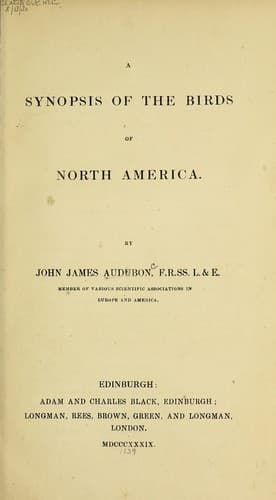
A Synopsis of the Birds of North AmericaAudubon, John James
Science
A Synopsis of the Birds of North America
Audubon, John James
Birds -- Classification; Birds -- North America
Breeds abundantly from Texas to New York. Very rare in Massachusetts.
Valleys of the Mississippi and Missouri, Kentucky and Ohio. Resident
from Maryland southward.
Cardinal Grosbeak, Loxia cardinalis, Wils. Amer. Orn. v. ii.
p. 38.
Fringilla cardinalis, Bonap. Syn. p. 113.
Cardinal Grosbeak or Red Bird, Fringilla cardinalis, Nutt.
Man. v. i. p. 519.
Cardinal Grosbeak, Fringilla cardinalis, Aud. Orn. Biog. v.
ii. p. 336; v. v. p. 514.
GENUS XVI. COCCOBORUS, Swains. SONG-GROSBEAK.
Bill rather short, extremely robust, almost as broad as the head and
somewhat compressed, tapering to a point; upper mandible considerably
smaller than the lower, with the dorsal line convex, the ridge
indistinct, the nasal sinus very wide, the sides convex, the edges
ascending for a third of their length, then direct, with a slight
festoon, and inflected, the notches faint, the tip a little deflected,
and narrow; lower mandible with the angle short and semicircular, the
dorsal line straight, the sides at the base inflected, toward the end
convex, the edges involute, the tip acute. Nostrils basal, round.
Plumage somewhat compact, blended; distinct bristles at the base of
the upper mandible. Wings of moderate length, pointed, the outer three
quills nearly equal, the second longest. Tail of moderate length,
slightly emarginate. Tarsus short, compressed, with seven scutella;
toes moderate, hind toe stout, broad beneath, outer toe slightly
longer than inner, and adherent at the base. Claws moderate, arched,
compressed, acute. Upper mandible concave beneath, with three
longitudinal ridges; tongue as high as broad, convex above, tapering
to a point; œsophagus rather wide, dilated about the middle;
stomach rather small, roundish, compressed, with its muscles distinct
and of moderate thickness, the epithelium longitudinally rugous;
intestine short, and of moderate width; cœca very small.
204. 1. Coccoborus cœruleus, Linn. Blue Song-Grosbeak.
Plate CXXII. Male, Female, and Young.
Male blue; with the lores, chin, and a line round the base of the
mandibles black; wings and tail brownish-black, the latter and the
primaries edged with blue, the first row of small coverts and the
secondary coverts tipped with reddish-brown. Female with the head and
hind part of the back blue; the fore part of the back brown, the wings
and tail as in the male, the lower parts light greyish-brown, the
sides, and fore part of the neck and the breast tinged with blue.
Young yellowish-brown, lighter beneath; the upper part of the head,
the back, smaller wing-coverts, and upper tail-coverts tinged with
dusky.
_Male_, 7-1/2, 11.
From Texas to New Jersey, and up the Mississippi to Memphis. Rocky
Mountains. Rather rare. Migratory.
Blue Grosbeak, Loxia cœrulea, Wils. Amer. Orn. v. iii. p.
78.
Fringilla cœrulea, Bonap. Syn. p. 114.
Blue Grosbeak, Fringilla cœrulea, Nutt. Man. v. i. p. 529.
Public-domain text, read in full here on John Shaqi.
Reviews
Reviews
No reviews yet
Be the first to share your thoughts on this work.
Elsewhere in the archive
Join the Discussion
Join the discussion
Sign in to leave a comment or review.
Sign InorCreate an account