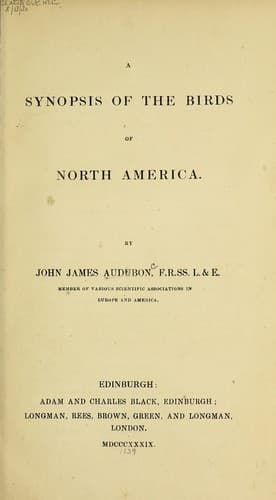
A Synopsis of the Birds of North AmericaAudubon, John James
Science
A Synopsis of the Birds of North America
Audubon, John James
Birds -- Classification; Birds -- North America
Bill of moderate length, extremely robust, almost as broad as the
head, not compressed, conical, pointed; upper mandible rather broader
than the lower, with the dorsal line slightly convex, the ridge
indistinct, the nasal sinus extremely wide and short, the sides
rounded, the edges simply arched and a little inflected, the notches
almost obsolete, the tip a little deflected; lower mandible with the
angle extremely short and wide, forming the fourth of a circle, the
dorsal line straight, the sides at the base and in their whole length
convex, the edges involute, the tip acute; nostrils basal, round.
Plumage blended. Wings of moderate length, pointed, the outer three
quills nearly equal, the second longest. Tail of moderate length,
emarginate. Tarsus short, compressed, with seven scutella; toes
moderate, hind toe stout, broad beneath; outer toe a little longer
than the inner, and adherent at the base. Claws moderate, or rather
stout, arched, compressed, acute. Upper mandible concave beneath, with
three prominent lines.
207. 1. Coccothraustes vespertina, Cooper. Evening Grosbeak.
Plate CCCLXXIII. Fig. 1. Male.
Plate CCCCXXIV. Fig 5. Female. Fig. 6. Young Male.
Male with the upper part of the head and hind neck black, bounded
anteriorly by a broadish band of bright yellow passing over the eyes;
a narrow line of black margining the base of the bill; cheeks, lower
part of hind neck, and throat, dark yellowish-olive, this colour
gradually brightening on the body, until, on the outer edges of the
scapulars, the rump, the axillars, lower wing-coverts, abdomen, and
lower tail-coverts, it becomes pure yellow; smaller wing-coverts,
alula, primary coverts, primaries, outer three secondaries, outer web
of the next, and the bases of the inner secondaries black, as is the
tail; six inner secondaries, and their coverts, the basal part
excepted, black. Female with the upper parts brownish-grey, the head
and cheeks darker, the lower parts pale grey, the throat white, with
two longitudinal black bands; a band of greenish-yellow across the
fore part of the back, axillars and lower wing-coverts light yellow;
wings and tail, with their coverts, brownish-black, secondary coverts,
and quills edged with yellowish-white, bases of some of the primaries,
tips of the tail-coverts, and inner webs of all the tail-feathers at
the end, white. Young male similar to the female, but without the
black bands on the throat.
_Male_, 8, wing 4-3/4. _Female_, 7-1/2, wing 4-1/4.
Michigan. Columbia River. Saskatchewan. Common. Migratory.
Fringilla vespertina, Cooper, Ann. Lyc. New York, v. i. p.
220.
Evening Grosbeak, Fringilla vespertina, Bonap. Syn. p. 113.
Evening Grosbeak, Fringilla vespertina, Bonap. Amer. Orn. v.
ii. pl. 14.
Coccothraustes vespertina, Evening Grosbeak, Swains. & Rich.
F. Bor. Amer. v. ii. p. 269.
Evening Grosbeak, Nutt. Man. v. i. p. 594.
Coccothraustes Bonapartii, Lesson, Young Male.
Public-domain text, read in full here on John Shaqi.
Reviews
Reviews
No reviews yet
Be the first to share your thoughts on this work.
Elsewhere in the archive
Join the Discussion
Join the discussion
Sign in to leave a comment or review.
Sign InorCreate an account