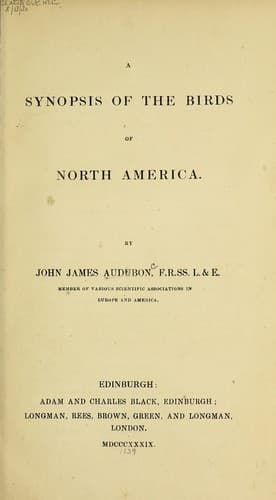
A Synopsis of the Birds of North AmericaAudubon, John James
Science
A Synopsis of the Birds of North America
Audubon, John James
Birds -- Classification; Birds -- North America
Tail considerably rounded. Male with the plumage glossy black, the
smaller wing-coverts scarlet, their first or posterior row
buff-coloured, at the tip whitish. Female much smaller, with the upper
parts dark brown, the feathers edged with light brown; some of the
smaller wing-coverts tinged with red; wings and tail blackish-brown,
the feathers margined with brownish-red, the first row of small
coverts and secondary coverts narrowly tipped with whitish; a
yellowish-brown band over the eye; lower parts longitudinally streaked
with dusky and whitish, the fore neck strongly tinged with dull
carmine. Young similar to the female, but without red on the small
wing-coverts or throat, the latter part with the sides of the head
being pale yellowish-brown.
_Male_, 9, 14. _Female_, 7-1/2.
Breeds from Texas throughout the United States, and northward to the
Saskatchewan. Vast numbers spend the winter in the Southern and
Western States.
Red-winged Starling, Sturnus prædatorius, Wils. Amer. Orn. v.
iv. p. 30.
Icterus phœniceus, Bonap. Syn. p. 52.
Agelaius phœniceus, Red-winged Maize-bird, Swains. & Rich.
F. Bor. Amer. v. ii. p. 280.
Red-winged Blackbird, Icterus phœniceus, Nutt. Man. v. i.
p. 169.
Red-winged Starling or Marsh-Blackbird, Aud. Orn. Biog. v. i.
p. 348; v. v. p. 487.
GENUS IV. ICTERUS, Briss. HANGNEST.
Bill a little shorter than the head, conical, very slightly decurved,
compressed, tapering to a very attenuated point; upper mandible with
the dorsal line almost straight, being very slightly convex, the ridge
indistinct, narrowed at the base; the sides convex, the edges
overlapping, the tip extremely sharp; gape-line ascending at the base,
afterwards direct; lower mandible with the angle long and of moderate
width, the dorsal line and that of the crura slightly concave, the
sides erect at the base, convex towards the end, the edges slightly
inflected, the tip extremely slender. Nostrils basal, elliptical, with
a small operculum. Head ovate, of moderate size; neck short; body
rather slender. Feet of moderate length, rather stout; tarsus much
compressed, with seven anterior scutella; toes of moderate size, the
hind toe much stronger, the lateral about equal, the third and fourth
united at the base. Claws rather long, moderately arched, much
compressed, laterally grooved, very acute. Plumage soft and blended.
Wings of moderate length, with the outer four quills nearly equal.
Tail of moderate length, rounded and slightly emarginate. Roof of the
upper mandible with a broad median ridge, somewhat prominent at the
base; tongue tapering to a deeply slit point; œsophagus wide,
considerably dilated about the middle; stomach elliptical; intestine
short, and of moderate width; cœca very small; cloaca globular.
217. 1. Icterus Baltimore, Linn. Baltimore Hangnest.--Golden Robin.
Plate XII. Adult and Young Male. Plate CCCCXXIII. Fig. 3.
Female.
Public-domain text, read in full here on John Shaqi.
Reviews
Reviews
No reviews yet
Be the first to share your thoughts on this work.
Elsewhere in the archive
Join the Discussion
Join the discussion
Sign in to leave a comment or review.
Sign InorCreate an account