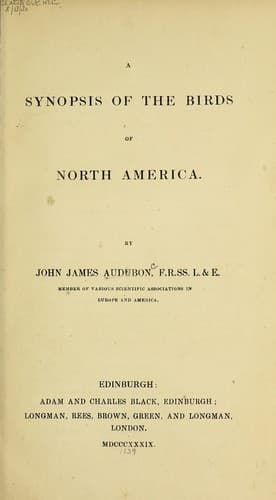
A Synopsis of the Birds of North AmericaAudubon, John James
Science
A Synopsis of the Birds of North America
Audubon, John James
Birds -- Classification; Birds -- North America
Bill long or of moderate length, straight, stout, angulate, tapering,
compressed toward the tip, which is generally wedge-shaped and abrupt;
mandibles nearly equal, outline of the upper slightly convex, the
ridge narrow, sides sloping, with a lateral ridge, edges straight;
lower with the angle short and narrow, the dorsal line nearly
straight, the ridge narrow, the sides with a faint ridge. Nostrils
basal, elliptical or oblong, concealed by reversed bristly feathers.
Head of moderate size, oblong; neck of moderate length; body stout.
Legs short; tarsus short, moderately stout, anteriorly scutellate,
scaly behind; toes usually four, first short, rudimentary, or
sometimes wanting, fourth very long and reversed, equalling or
exceeding the third. Claws large, strong, much curved, much
compressed, very acute. Plumage soft, blended, rather compact on the
back; wings of moderate length or long; with the first quill very
small, the third, fourth, and fifth longest. Tail of moderate length,
much rounded or cuneate, of twelve feathers, of which the lateral are
extremely small, and placed above the next, the rest, but especially
the three middle pairs, with the shafts exceedingly large and strong,
the webs narrowed toward the end, with their filaments deflected and
stiff, the tip pointed or emarginate from being worn. Tongue slender,
with the tip horny and furnished with reversed prickles or bristles,
capable of being protruded to a great length by the elongation of the
hyoid bones, which curve over the head to between the right eye and
nostril, or even extend round a great part of that eye. Œsophagus
of uniform width; proventriculus extremely large; stomach of moderate
size, or rather small, broadly elliptical or roundish, moderately
muscular; epithelium thin, dense, and longitudinally rugous; intestine
of moderate length, rather wide; no cœca; cloaca very large,
globular, or elliptical. Trachea simple, with a single pair of
inferior laryngeal muscles. Nest a cavity dug in a tree; eggs from
four to six, elliptical, white.
The groups present characters which are so undecided, and exhibit such
gradual approximations, that I think it better here to consider all
our Woodpeckers as of one genus.
GENUS I. PICUS, Linn. WOODPECKER.
Character as above.
* Bill straight, with the angles prominent.
256. 1. Picus imperialis, Gould. Imperial Woodpecker.
Not figured.
Glossy greenish-black; the elongated occipital crest scarlet; a
triangular spot on the fore part of the back; the secondary quills,
and the inner webs of most of the primaries, white; bill
yellowish-white. Female similar, but without red on the head. Gould.
_Male_, 24, wing 12.
Rocky Mountains and North California.
Picus imperialis, Gould. Proceed. of Com. Sc. and Corresp. of
Zool. Soc. of Lond. part ii. p. 140.
Imperial Woodpecker, Picus Imperialis, Aud. Orn. Biog. v. v.
p. 313.
257. 2. Picus principalis, Linn. Ivory-billed Woodpecker.
Public-domain text, read in full here on John Shaqi.
Reviews
Reviews
No reviews yet
Be the first to share your thoughts on this work.
Elsewhere in the archive
Join the Discussion
Join the discussion
Sign in to leave a comment or review.
Sign InorCreate an account