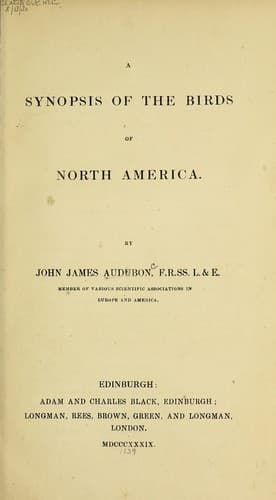
A Synopsis of the Birds of North AmericaAudubon, John James
Science
A Synopsis of the Birds of North America
Audubon, John James
Birds -- Classification; Birds -- North America
Third and fourth toes about equal, hind toe very small; an occipital
crest of elongated near feathers; upper part of the head carmine,
inclining to scarlet; a narrow dusky line from the nostril to the eye;
a patch, including the eyelids and ear-coverts, leaden-grey; a narrow
band down the hind part of the neck, gradually enlarging, the back,
wings, and tail, deep black; a band from the nostrils descending
obliquely over the side of the head, passing backwards and behind the
ear, then much enlarged, and running down the side of the neck to the
shoulders, a large oblique patch at the commencement of the wing,
including the outer scapulars, the small feathers on the edge of the
wing under the alula, the lower wing-coverts, and the inner webs of
the quills for about half the length, pure white; an elongated crimson
patch at the base of the lower jaw; chin yellowish-white,
longitudinally streaked with dusky; the rest of the fore neck and part
of the breast black; the lower parts and sides brownish-white,
transversely barred with black.
_Male_, 15, wing, 7-2/12.
Columbia River.
Picus lineatus, Linn. Syst. Nat v. i. p. 174.
Lineated Woodpecker, Picus lineatus, Aud. Orn. Biog. v. v. p.
315.
260. 5. Picus Canadensis, Gmel. Canadian Woodpecker.
Plate CCCCXVII. Fig. 7. Male.
Fourth toe considerably longer than third; fourth quill longest, fifth
longer than second; bristly feathers over the nostrils dull yellow;
upper part of head and hind neck glossy black; over the eye a band of
white, continuous with a transverse band of scarlet on the occiput,
usually interrupted in the middle; a black band from near the bill to
the eye, continued behind it over the auriculars, and joining the back
of the hind neck; beneath this a white band from the angle of the
mouth, curving backwards below the middle of the neck, so as to meet
the other behind; then a narrow band of black from the base of the
lower mandible and continuous with the black of the shoulders; upper
part of the body, wings, and tail, black, feathers along the middle of
the back tipped with white; wing-coverts, the anterior excepted, and
quills spotted with the same, there being on the four longest
primaries seven spots on the outer, and five on the inner webs, on
most of the secondaries five on each web, but on the outer quill only
one patch on each web, and on the second three spots on the outer, and
four on the inner web; four middle tail-feathers glossy black, the
rest black towards the base, that colour gradually diminishing, so
that the outermost is almost entirely white; lower parts white.
Extremely similar to Picus villosus, but always much larger.
_Male_, 10-1/2, 17-3/4.
From the northern parts of New York to the Fur Countries. Common.
Migratory in winter to New York.
Picus canadensis, Gmel. Syst. Nat. v. i. p. 437.
Picus (Dendrocopus) villosus, Hairy Woodpecker, Swains. &
Rich. F. Bor. Amer. v. ii. p. 305.
Public-domain text, read in full here on John Shaqi.
Reviews
Reviews
No reviews yet
Be the first to share your thoughts on this work.
Elsewhere in the archive
Join the Discussion
Join the discussion
Sign in to leave a comment or review.
Sign InorCreate an account