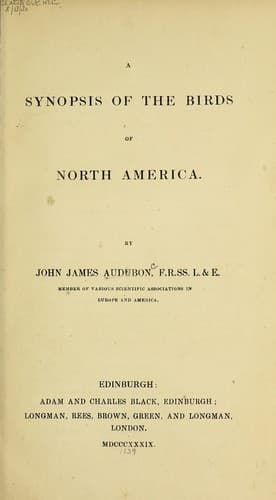
A Synopsis of the Birds of North AmericaAudubon, John James
Science
A Synopsis of the Birds of North America
Audubon, John James
Birds -- Classification; Birds -- North America
Bill as long as the head; fourth toe considerably longer than third;
fourth and fifth quills longest and equal; bristly feathers over the
nostrils dull yellow, tipped with black; upper part of head and hind
neck glossy black; over the eye a band of white, continuous with a
transverse band of scarlet on the occiput, usually divided in the
middle; a black band from the bill to the eye, continued behind it
over the auriculars, and joining the black of the hind neck; beneath
this, a band of white from the angle of the mouth, curving backwards
below the middle of the neck, so as to meet its fellow behind; then a
black band from the base of the lower mandible; upper parts black,
tinged with brown behind; feathers along the middle of the back,
tipped with white; wing-coverts, the anterior excepted, and quills
spotted with white, there being on the four longest primaries seven on
the outer and five on the inner web, on most of the secondaries five
on each web, but on the outer quill only one patch on each web, and on
the second, two spots on the outer and three on the inner; four middle
tail-feathers glossy black, the rest black only towards the base;
lower parts white, tinged with dull green on the fore neck and breast,
the sides with blackish-grey. Female without red on the head.
_Male_, 8-3/4, 14-1/2. _Female_, 8-1/2, 15.
Breeds from Texas to New Hampshire, Kentucky, and Valley of the
Mississippi. Common. Resident.
Hairy Woodpecker, Picus villosus, Wils. Amer. Orn. v. i. p.
150.
Picus villosus, Bonap. Syn. p. 46.
Hairy Woodpecker, Nutt. Man. v. i. p. 575.
Hairy Woodpecker, Picus villosus, Aud. Orn. Biog. v. v. p.
164.
265. 10. Picus pubescens, Linn. Downy Woodpecker.
Plate CXII. Male and Female.
Bill much shorter than the head, slender; fourth toe considerably
longer than third; fourth quill longest; upper bristles over the
nostrils yellowish, tipped with black; upper part of the head glossy
black; a band of white over the eye ending in a scarlet occipital
band; then a band of black from the eye to the hind neck, succeeded by
one of white from the angle of the mouth, curving so as nearly to meet
its fellow on the hind neck, and a black band from the lower mandible
down the side of the neck. Upper parts black; feathers along the
middle of the back tipped with white; coverts and quills spotted with
white, there being six spots on the outer, and five on the inner webs
of the four longest primaries, the outermost quill with one patch of
white on the inner web, and the next with four spots on each web;
outer small tail-feathers white, with a single black spot, next two
white, with two terminal black bands, the rest variegated, except the
two middle, which are black. Female without red.
_Male_, 6-3/4, 12.
Breeds from Texas to Labrador, and northward to Lat. 58°. Common
throughout the interior to the eastern bases of the Rocky Mountains.
In every district, a constant resident.
Public-domain text, read in full here on John Shaqi.
Reviews
Reviews
No reviews yet
Be the first to share your thoughts on this work.
Elsewhere in the archive
Join the Discussion
Join the discussion
Sign in to leave a comment or review.
Sign InorCreate an account