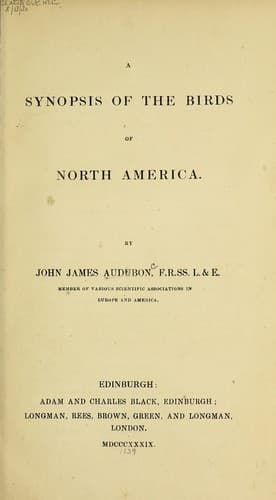
A Synopsis of the Birds of North AmericaAudubon, John James
Science
A Synopsis of the Birds of North America
Audubon, John James
Birds -- Classification; Birds -- North America
Bill very thick, convex, with a strong ridge on each side of the lower
mandible; claws (when entire) elongated, arched with the sides
sloping, edges thin and nearly parallel, the tip rounded; tail short,
slightly rounded, of fourteen feathers, independently of the long
incumbent coverts. Bill black, claws dusky at the base, yellowish-grey
on the edges and tip. In winter, the plumage white, excepting the
shafts of the primaries, which are brown, and the tail-feathers, which
are black, narrowly tipped with white, and with the base of the same
colour. In summer, the male with the head and neck bright chestnut,
more or less variegated with dusky; the upper parts and sides having
the feathers brownish-black, transversely barred with reddish-yellow,
and narrowly tipped with white; the quills and larger coverts, with
most of the smaller, middle of breast, abdomen, and feet, white; tail
as in winter, the middle incumbent feather like the back. Female
similar, with the markings larger, the breast and abdomen coloured
like the sides, the head and neck without chestnut. Young, when in
down, of a yellowish tint, variegated above with large streaks of dark
brown, the top of the head with a longitudinal patch of brown, edged
with black. When fledged, the young resemble the female.
_Male_, 17, 26-1/2. _Female_, 16, 26.
In Maine, New Brunswick, and Nova Scotia, during winter. Breeds
plentifully in Newfoundland, Labrador, and the Fur Countries. Rocky
Mountains.
Tetrao (Lagopus) saliceti, Willow Grouse, Swains. & Rich. F.
Bor. Amer. v. ii. p. 351.
Willow Grouse or Large Ptarmigan. Nutt. Man. v. i. p. 674.
Willow Grouse, Tetrao saliceti, Aud. Orn. Biog. v. ii. p. 528.
302. 2. Lagopus Americanus, Aud. American Ptarmigan.
Not figured.
Bill much narrower, with the ridge on each side of the lower mandible
obsolete; claws (when entire) elongated, arched, with the sides
sloping, the edges thin and nearly parallel, the tip round; tail
short, even, of fourteen feathers, independently of the long incumbent
coverts. In winter, the plumage white, excepting the shafts of the
primaries, which are brown, and the tail-feathers, which are black,
narrowly tipped with white; male with a black loral band, extending
beyond the eye. In summer, the general colour of the upper parts, fore
neck, and sides, reddish-yellow, finely undulated transversely with
blackish-brown, and greyish-white; the bars on the head and neck
larger; the two long incumbent tail-feathers similar to those of the
back; the rest brownish-black, tipped with white; little white on the
lower parts, and only in patches, some greyish-white undulations
occasionally seen, tend to approximate the colouring to that of some
specimens of _Lagopus mutus_ of Scotland, but the prevailing tint is
not grey, as in that species, but brownish-yellow. Young similar to
the adult, with the bands larger; the fore part of the wings, the
primaries, secondary coverts, and abdomen, white.
Public-domain text, read in full here on John Shaqi.
Reviews
Reviews
No reviews yet
Be the first to share your thoughts on this work.
Elsewhere in the archive
Join the Discussion
Join the discussion
Sign in to leave a comment or review.
Sign InorCreate an account