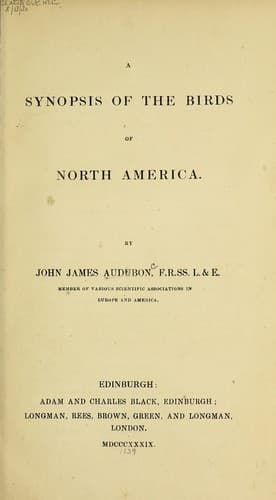
A Synopsis of the Birds of North AmericaAudubon, John James
Science
A Synopsis of the Birds of North America
Audubon, John James
Birds -- Classification; Birds -- North America
Bill much longer than the head, slender, compressed, very slightly
decurved, high at the base; upper mandible with the dorsal line almost
straight, until towards the end, where it is slightly curved, the
ridge a little flattened at the base, and extending slightly on the
forehead, convex toward the end, nasal sinus forming a groove
extending to two-thirds, the sides nearly erect, the edges slightly
inflected, the notches very slight, the tip rather obtuse; lower
mandible with the angle very long and extremely narrow, the dorsal
line almost straight, the sides erect and a little convex, the edges
involute, the tip narrowed but obtuse. Nostrils lateral, subbasal,
linear. Head, small, oblong, much compressed; neck long and slender;
body slender, much compressed. Feet long; tibia, bare below; tarsus
rather long, stout, compressed anteriorly covered with broad scutella;
hind toe very small and tender, fourth little longer than second,
anterior toes very long, scutellate, compressed. Claws of moderate
length, arched, slender, much compressed, acute. Plumage rather
stiff; feathers of the forehead with the shaft enlarged, and extended
beyond the tip. Wings very short and broad; third quill longest. Tail
very short, much rounded, of twelve feeble rounded feathers, scarcely
longer than the coverts.
311. 1. Rallus elegans, Aud. Great Red-breasted Rail.--Fresh-water
Marsh-Hen.
Plate CCIII. Male and Young.
Upper part of head and hind neck dull brown; a brownish-orange line
over the eye; lower eyelid white; loral space and band behind the eye
dusky; upper parts of the body streaked with brownish-black and light
olive-brown, the two sides of each feather being of the latter colour;
wing-coverts dull chestnut; most of the irregularly tipped with white
primaries deep olive-brown; secondaries and tail-feathers like the
back; sides and fore part of neck, with the breast, bright
orange-brown; sides of the body and lower wing-coverts undulated with
deep brown and greyish-white; tibial feathers pale greyish-brown,
faintly barred with darker, as is the hind part of the abdomen; lower
tail-coverts white, each with a blackish-brown spot near the end,
those in the middle barred with black and white. Female and young
similar, but with the tints duller. Iris bright red.
_Male_, 19, 25. _Female_, 18, 24.
From Texas to New Jersey, more common from Louisiana to North
Carolina. Inland swamps and marshes. Once met with in Kentucky.
Great Red-breasted Rail, Rallus elegans, Aud. Orn. Biog. v.
iii. p. 27.
312. 2. Rallus crepitans, Gmel. Clapper Rail.--Salt-water Marsh-hen.
Plate CCIV. Male and Female.
Public-domain text, read in full here on John Shaqi.
Reviews
Reviews
No reviews yet
Be the first to share your thoughts on this work.
Elsewhere in the archive
Join the Discussion
Join the discussion
Sign in to leave a comment or review.
Sign InorCreate an account