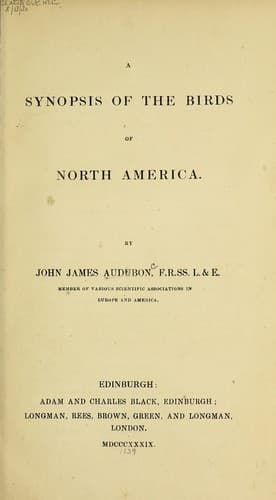
A Synopsis of the Birds of North AmericaAudubon, John James
Science
A Synopsis of the Birds of North America
Audubon, John James
Birds -- Classification; Birds -- North America
Bill about the length of the head, straight, and with the feet black;
hind toe wanting. In winter the general colour of the plumage
ash-grey, the lower parts pure white; alula and primaries
brownish-black, the latter with more or less white on their outer
webs, or along the shaft; secondaries white, the outer with a patch of
black towards the end, the inner ash-grey; primary coverts
greyish-black, tipped with white; middle tail-feathers greyish-brown,
their shafts white, the rest of a paler tint on the outer webs, white
on the inner, the lateral almost pure white. In summer the upper parts
of the head, hind neck, lateral, and fore part of the neck, pale
yellowish-red, streaked with brownish-black; the back similarly
marked, with larger spots, and on the scapulars disposed in bars; the
tips of most of the feathers greyish-white; the other parts as in
winter.
_Male_, 7-10/12, 12-1/2.
From Texas along the coast to Maine in autumn and spring, extremely
abundant. Breeds from Lat. 55° northward.
Ruddy Plover, Charadrius rubidus, Wils. Amer. Orn. v. vii. p.
129. Summer.
Sanderling Plover, Charadrius Calidris, Wils. Amer. Orn. v.
vii. p. 68. Winter.
Calidris arenaria, Sanderling, Swains. & Rich. F. Bor. Amer.
v. ii. p. 366.
Sanderling Plover, Calidris arenaria, Nutt. Man. v. ii. p. 4.
Sanderling, Tringa arenaria, Aud. Orn. Biog. v. iii. p. 231;
v. v. p. 582.
GENUS II. PHALAROPUS, Briss. PHALAROPE.
Bill scarcely longer than the head, straight, slender, at the base
somewhat cylindrical, toward the end broader and flattened, the tips
narrowed; upper mandible with the dorsal line straight, excepting at
the end, where it is a little decurved, the ridge convex, flattened at
the broad part, the sides slightly sloping, the edges rounded, and
near the tip inflected; nasal groove linear, extending to near the
tip; lower mandible with the angle very long and narrow, the sides
convex and sloping outwards, the tip narrowed. Nostrils basal,
linear-elliptical. Head small, with the fore part high and rounded;
neck of moderate length; body rather full. Feet rather short, slender;
tibia bare a short way above the joint; tarsus much compressed,
narrowed before and behind, covered anteriorly with numerous scutella;
toes very slender, first extremely small, free, with a slight membrane
beneath; second shorter than the fourth; third toe much longer, all
scutellate above, the anterior margined on both sides with lobed and
pectinated membranes, which are united at the base, so as to render
the foot nearly half-webbed, the outer web much longer than the inner.
Claws very small, compressed, arched, obtuse. Plumage soft and
blended; wings long and pointed, first quill longest, secondary quills
rather short, the inner much elongated. Tail of moderate length, much
rounded, of twelve feathers, the lower tail-coverts as long.
340. 1. Phalaropus fulicarius, Bonap. Red Phalarope.
Public-domain text, read in full here on John Shaqi.
Reviews
Reviews
No reviews yet
Be the first to share your thoughts on this work.
Elsewhere in the archive
Join the Discussion
Join the discussion
Sign in to leave a comment or review.
Sign InorCreate an account