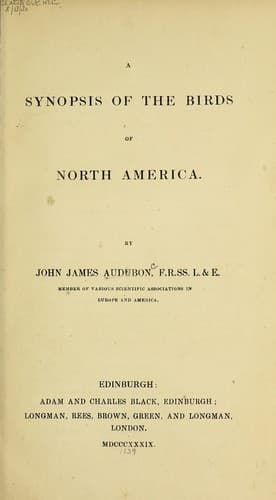
A Synopsis of the Birds of North AmericaAudubon, John James
Science
A Synopsis of the Birds of North America
Audubon, John James
Birds -- Classification; Birds -- North America
Bill a little longer than the head, very slender, flexible, greenish
above, yellow beneath, legs rather long and slender, pale
flesh-colour; upper parts glossy greenish-olive, with bronze
reflections, the head longitudinally streaked, the back transversely
undulated with dusky; lower parts white, marked with numerous
brownish-black spots, smaller on the throat, largest and roundish on
the breast and sides. Young with the upper feathers of the upper parts
terminally margined with dusky, the wing-coverts barred, the lower
parts pure white.
_Male_, 8, 13-3/4.
Breeds from the Texas along the shores to Maine, the islands of the
Gulf of St. Lawrence, and Labrador. Inland all over the country. Very
common. Resident in the Southern States. Columbia River.
Spotted Sandpiper, Tringa macularia, Wils. Amer. Orn. v. vii.
p. 60.
Totanus macularius, Bonap. Syn. p. 325.
Spotted Tatler or Peet-weet, Nutt. Man. v. ii. p. 162.
Spotted Sandpiper, Totanus macularius, Aud. Orn. Biog. v. iv.
p. 81.
344. 2. Totanus solitarius, Wils. Solitary Tatler.--Solitary
Sandpiper.
Plate CCLXXXIX. Male and Female.
Bill a little longer than the head, very slender, greenish-black;
feet greenish-grey, long; upper part of head, lores, cheeks, hind
part and sides of neck greyish-brown, streaked with brownish-white; a
dull white line from the bill to the eye; upper part of throat
greyish-white; fore neck of the same colour, streaked with
greyish-brown; the rest of the lower parts white; the axillars and
wing-coverts broadly barred with dusky; back and scapulars deep
greenish-brown, the feathers edged with a few small spots of white and
dusky, those of the inner secondaries more numerous; larger
wing-coverts similar; smaller coverts, primary coverts, and primaries,
deep brownish-black, secondaries greyish-brown; tail feathers and
coverts broadly banded with white and brownish-black, except the two
middle, which are merely spotted with white on the edges.
_Male_, 8-1/2, 16-1/2.
Distributed from Texas over the United States, breeding in deep woody
situations, in the Fur Countries on the bare sand. Columbia River.
Partially migratory.
Solitary Sandpiper, Tringa solitaria, Wils. Amer. Orn. v. vii.
p. 53.
Totanus chloropygius, Bonap. Syn. p. 325.
Totanus chloropygius, Green rump Tatler, Swains. & Rich. F.
Bor. Amer. v. ii. p. 393.
Green-rump Tatler, Totanus chloropygius, Aud. Orn. Biog. v.
iii. p. 576; v. v. p. 583.
345. 3. Totanus flavipes, Lath. Yellowshanks Tatler.--Yellowshanks
Snipe.
Plate CCLXXXVIII. Male.
Public-domain text, read in full here on John Shaqi.
Reviews
Reviews
No reviews yet
Be the first to share your thoughts on this work.
Elsewhere in the archive
Join the Discussion
Join the discussion
Sign in to leave a comment or review.
Sign InorCreate an account