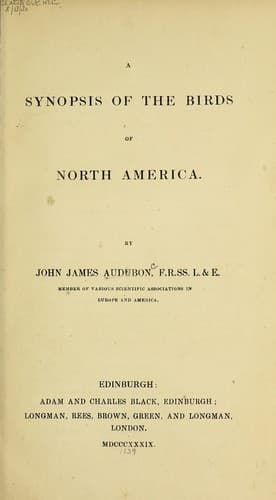
A Synopsis of the Birds of North AmericaAudubon, John James
Science
A Synopsis of the Birds of North America
Audubon, John James
Birds -- Classification; Birds -- North America
Bill twice the length of the head, very slender, much depressed,
tapering to a point, and slightly recurved; upper mandible with the
dorsal line straight for half its length, then a little curved
upwards, and at the tip slightly decurved, the ridge broad and
flattened, the edges rather thick; nasal groove rather long and very
narrow; lower mandible with the angle long and very narrow, the dorsal
line slightly curved upwards, the point very slender, extremely thin,
and a little curved upwards. Nostrils linear, basal. Head small,
rounded above, rather compressed; neck long; body compact. Legs very
long, slender; tibia bare for half its length, and reticulated; tarsus
very long, compressed, reticulated with hexagonal scales; toes rather
short, the first extremely small; outer toe a little longer than
inner; anterior toes connected by webs of which the anterior margin is
deeply concave. Claws very small, compressed, rather acute. Plumage
soft and blended. Wings long, pointed, the first quill longest; inner
secondaries elongated and tapering. Tail short, even, of twelve rather
narrow rounded feathers. Tongue short in proportion to the length of
the bill, slender, tapering to a point; œsophagus wide,
considerably dilated at the lower part of the neck; stomach an oblong
gizzard of moderate strength, its epithelium hard, longitudinally
rugous; intestine long and of moderate width; cœca rather long.
355. 1. Recurvirostra Americana, Linn. American Avocet.
Plate CCCXVIII. Adult, and Young in winter.
Bill black; feet light blue; head, neck, and fore part of breast
reddish-buff, the parts around the base of the bill and the eye nearly
white; back white, with a longitudinal band of brownish-black
elongated feathers on each side; inner scapulars of the same colour,
the outer and interior edge of the wing being white; wing
brownish-black, with a broad band of white, formed by the tips of the
secondary coverts, four of the inner secondaries, and the basal part,
with the inner webs and outer edges of the rest; lower parts white.
_Male_, 18, 30-5/8.
Passes along the coast from Texas northward, in small numbers, a few
breeding in New Jersey. Indiana, Illinois, and Missouri. Abundant in
the Rocky Mountains, and the Fur Countries. Migratory.
American Avocet, Recurvirostra Americana, Wils. Amer. Orn. v.
vii. p. 126.
Recurvirostra Americana, Bonap. Syn. p. 394.
Recurvirostra Americana, American Avocet, Swains. & Rich. F.
Bor. Amer. v. ii. p. 375.
American Avocet, Nutt. Man. v. ii. p. 74.
American Avocet, Recurvirostra Americana, Aud. Orn. Biog. v.
iv. p. 168.
GENUS IX. HIMANTOPUS, Briss. STILT.
Public-domain text, read in full here on John Shaqi.
Reviews
Reviews
No reviews yet
Be the first to share your thoughts on this work.
Elsewhere in the archive
Join the Discussion
Join the discussion
Sign in to leave a comment or review.
Sign InorCreate an account