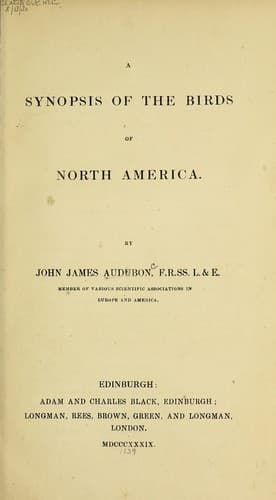
A Synopsis of the Birds of North AmericaAudubon, John James
Science
A Synopsis of the Birds of North America
Audubon, John James
Birds -- Classification; Birds -- North America
Bill very long, excessively depressed, being, when viewed laterally,
very slender; but, when seen from above, nearly as broad as the head
at the base, considerably contracted in the middle, and at the end
expanded into a large obovate disk much broader than the head; upper
mandible with the dorsal line almost straight, at the tip decurved,
the ridge extremely broad and flat, gradually widening beyond the
nostrils, at the end terminated by the very small, decurved, blunt
unguis, the sides declinate at the base, horizontally flattened
towards the end, separated in their whole length from the ridge by a
narrow groove, their margins soft and blunt; lower mandible with the
angle very long, narrow, rounded, the coma narrow, and gradually
flattened, the extremity expanded into a flattened disk, as in the
upper; both mandibles covered with soft skin, which, for half their
length, is rough, with roundish plates, having their anterior margin
somewhat prominent. Nostrils basal, oblong-linear, of moderate size.
Head of moderate size, flattened above; neck long and slender; body
compact, ovate; legs long and rather stout; tibia bare in its lower
half, and reticulate; tarsus rather long, stout, roundish, covered all
round with subhexagonal scales; toes rather long, moderately stout,
scutellate, at the base reticulate; first more slender, articulated at
the same level, second considerably shorter than third. Claws
moderate, arched, compressed, laterally grooved, rather obtuse. Head,
gular sac, and a small part of neck, destitute of feathers. Wings long
and very broad, the second quill longest. Tail short, even, of twelve
rather broad feathers. Tongue extremely small, broader than long;
gular sac dilatable; œsophagus wide, with a dilatation at the lower
part of the neck; proventriculus bulbiform; stomach a powerful
gizzard, roundish, with large muscular fasciculi not disposed into
distinct muscles, the epithelium very thick, longitudinally fissured;
intestine very long, of moderate width; cœca two slight knobs.
364. 1. Platalea Ajaja, Linn. Roseate Spoonbill.
Plate CCCXXI. Male.
Bill greyish-blue, at the base mottled with dusky; feet pale lake;
head yellowish-green; space around the eye and gular sac
orpiment-orange; a band of black from the lower mandible to the
occiput; feathers of the neck white; back and wings rose-coloured;
lower parts of a deeper colour; tuft of recurved feathers on fore
neck, a broad band across the wing, along the cubitus, and the upper
and lower tail-coverts, rich carmine, with silky lustre; shafts of
quills and scapulars light carmine; on each side of the lower part of
the neck a patch of pale ochre; tail-feathers ochre-yellow, but at the
base roseate.
_Male_, 30-3/4, 53. _Female_, 28, 48.
Constant resident in the Texas, South Florida, and as far eastward as
North Carolina, where it is however very rare. Occasionally in summer
up the Mississippi to Natchez. Breeds in flocks on trees, low bushes,
or cactuses.
Public-domain text, read in full here on John Shaqi.
Reviews
Reviews
No reviews yet
Be the first to share your thoughts on this work.
Elsewhere in the archive
Join the Discussion
Join the discussion
Sign in to leave a comment or review.
Sign InorCreate an account