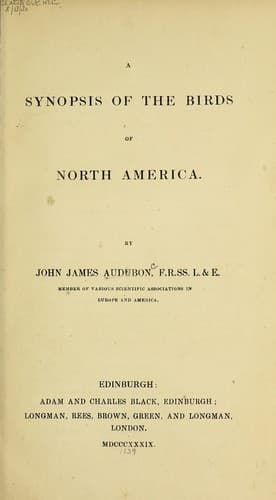
A Synopsis of the Birds of North AmericaAudubon, John James
Science
A Synopsis of the Birds of North America
Audubon, John James
Birds -- Classification; Birds -- North America
Bill longer than the head, higher than broad at the base, depressed,
and a little widened toward the end, rounded; upper mandible with the
dorsal line sloping, the ridge very broad at the base, with a large
depression; narrowed between the nostrils, convex toward the end, the
sides nearly erect at the base, gradually becoming more horizontal and
convex toward the end, the sides soft and thin, with numerous
transverse little elevated internal lamellæ, the unguis obovate; nasal
groove elliptical, subbasal, covered by the soft membrane of the bill;
lower mandible flattened, with the angle very long, and rather narrow,
the sides convex, the edges with numerous transverse lamellæ. Nostrils
submedial, longitudinal, placed near the ridge, elliptical. Head of
moderate size, oblong, compressed; neck extremely long and slender;
body very large, compact, depressed. Feet short, stout, placed a
little behind the centre of the body; tibia bare for a very small
space; tarsus short, a little compressed, covered all round with
angular scales; hind toe extremely small, with a very narrow membrane;
third longest, fourth very little shorter; anterior toes covered with
angular scales for nearly half their length, then scutellate, and
connected by broad reticulated entire membranes. Claws rather small,
strong, arched, compressed, rather obtuse. Space between the bill and
eye bare; plumage dense and soft. Wings long, broad; primaries curved,
stiff, the second longest. Tail very short, graduated, of twenty or
more feathers. Œsophagus very slender, at the lower part of the
neck a little dilated; stomach transversely elliptical, with the
lateral muscles extremely large, the epithelium dense, with two
concave grinding surfaces; intestine long, and of moderate width;
cœca rather large, narrow; cloaca globular. Trachea generally
enters a cavity in the sternum, whence it is reflected, before it
passes into the thorax; no inferior laryngeal muscles.
384. 1. Cygnus Buccinator, Richardson. Trumpeter Swan.
Plate CCCCVI. Adult Male. Plate CCCLXXVI. Young after first
moult.
Tail-feathers twenty-four; bill and feet black; plumage pure white,
excepting the upper part of the head, which is often brownish-red.
Young after first moult with the bill flesh-coloured in the middle,
the feet dull yellowish-brown; upper part of head and cheeks bright
reddish-brown, each feather tipped with whitish; throat nearly white;
general colour of the other parts greyish-white, slightly tinged with
yellow.
_Adult_, 68; wing, 27. _Young_, 52-1/2, 91.
Breeds from North California northward. Fur Countries. Abundant during
winter on the Missouri, Mississippi, Ohio, and in Texas. Never seen
eastward of South Carolina.
Cygnus Buccinator, Richardson's Trumpeter Swan, F. Bor. Amer.
v. ii. p. 464.
Trumpeter Swan, Cygnus Buccinator, Nutt. Man. v. ii. p. 370.
Trumpeter Swan, Cygnus Buccinator, Aud. Orn. Biog. v. iv. p.
536; v. v. p. 114.
Public-domain text, read in full here on John Shaqi.
Reviews
Reviews
No reviews yet
Be the first to share your thoughts on this work.
Elsewhere in the archive
Join the Discussion
Join the discussion
Sign in to leave a comment or review.
Sign InorCreate an account