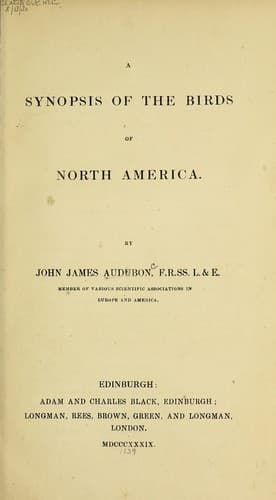
A Synopsis of the Birds of North AmericaAudubon, John James
Science
A Synopsis of the Birds of North America
Audubon, John James
Birds -- Classification; Birds -- North America
Bill shorter than the head, very high at the base; tail short,
graduated, of sixteen feathers. Male in summer with the bill black,
feet orange-yellow, webs dusky; head and upper part of neck deep
greenish-blue, changing to deep dusky purple; back, posterior
scapulars, inner secondaries, edge of wing, alula, primary coverts,
primary quills, and outer four secondaries black; an oblong curved or
semilunar patch of white between the bill and eye; lower part of neck
all round, sides of the body anteriorly, lower parts generally,
scapulars, excepting their margins, which are black, a broad band
across the wing formed by the first row of small coverts, and several
of the others, of which the base only is black, and a large patch
formed by the tips of some of the secondary coverts, and six of the
secondary quills, pure white; the two patches on the wings separated
by an intervening band of black; axillar feathers and lower
wing-coverts dusky; elongated feathers of the sides with the inner,
some of them also the outer margins, and many with a large portion of
the tip black, that colour on those of the innermost covering the
whole inner webs; tail brownish-grey. Male in winter similar, but with
the white patch on the side of the head elliptical, and the black band
separating the white patches on the wing not apparent, although seen
on turning aside the tips of the smaller coverts. Female with the bill
dusky, but having a portion toward the end yellow; head and upper part
of neck dull reddish-brown; lower part of the neck and sides of the
body brownish-grey, the feathers margined with pale grey, the rest of
the lower parts white; upper parts greyish-brown, much darker behind;
wings brownish-black, seven of the coverts, unless at the base, white;
the small coverts lighter and tipped with grey; tail brownish-grey.
_Male_, 20, 31-1/2. _Female_, 16, 28.
Abundant during winter on all the running streams of the interior, as
well as along the Atlantic coast, as far south as the Gulf of Mexico.
Breeds in high northern latitudes. Accidental in the North-eastern
Districts. Rocky Mountains, and Columbia River.
Golden-eye, Anas Clangula, Wils. Amer. Orn. v. viii. p. 62.
Fuligula Clangula, Bonap. Syn. p. 393.
Clangula vulgaris, Common Golden-eye, Swains. & Rich. F. Bor.
Amer. v. ii. p. 456.
Clangula Barrovii, Rocky-mountain Garrot, Swains. & Rich. F.
Bor. Amer. v. ii. p. 453.
Common Golden-eye, Nutt. Man. v. ii. p. 441.
Golden-eye Duck, Fuligula Clangula, Aud. Orn. Biog. v. iv. p.
318; v. v. p. 105.
408. 13. Fuligula dispar, Gmel. Western Duck.
Plate CCCCXXX. Male.
Public-domain text, read in full here on John Shaqi.
Reviews
Reviews
No reviews yet
Be the first to share your thoughts on this work.
Elsewhere in the archive
Join the Discussion
Join the discussion
Sign in to leave a comment or review.
Sign InorCreate an account