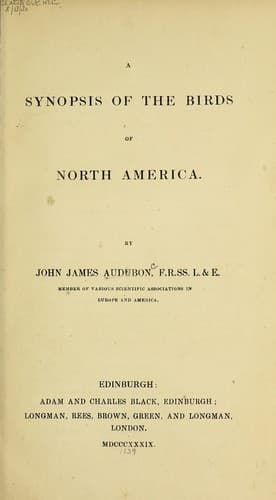
A Synopsis of the Birds of North AmericaAudubon, John James
Science
A Synopsis of the Birds of North America
Audubon, John James
Birds -- Classification; Birds -- North America
Bill rather long, straight, rather slender but strong, tapering,
higher than broad at the base, nearly cylindrical toward the end;
upper mandible with the dorsal outline sloping gently to the middle,
then straight, along the unguis suddenly decurved; the ridge broad and
flattened at the base, then convex, the sides sloping, toward the end
convex, the edges serrate internally with oblique dentiform lamellæ,
the unguis oblong, much curved, abruptly rounded at the end; nasal
groove elongated, covered by the soft skin of the bill; lower mandible
with the angle very narrow and extended to the unguis, which is
obovate, the sides nearly erect, with a long narrow groove, the edges
internally serrate, the unguis convex, thick-edged. Head rather large,
compressed, oblong; neck of moderate length; body full, depressed,
rather elongated. Feet placed far behind, stout; tibia bare for a
short space; tarsus very short, compressed, anteriorly covered with
small scutella, and another series on the lower half externally. Hind
toe very small, with an inferior free membrane; anterior toes half as
long again as the tarsus, second shorter than the fourth, which is
almost as long as the third, all scutellate, and connected by
anteriorly concave webs. Claws rather small, moderately arched,
compressed, acute. Plumage moderately full, dense, soft, glossy,
blended beneath. Wings of moderate breadth, convex, acute; inner
secondaries elongated and tapering. Tail short, much rounded, of more
than twelve feathers. Upper mandible with an internal series of small
papillæ or laminæ on each side, besides those on the margin. Tongue
long, fleshy, emarginate and papillate at the base, tapering, with a
double row of slender reversed papillæ along the upper surface, and
two lateral series of filaments on each side, the tip lacerated;
œsophagus very wide, of nearly uniform diameter; stomach a strong
gizzard of moderate or small size, with the lateral muscles thick;
epithelium dense and longitudinally rugous; intestine long, rather
narrow; cœca rather long; cloaca globular. Trachea with one or two
extensive dilatations, besides the enormously developed tympanum at
the bifurcation; no inferior laryngeal muscles. Nest on the ground, or
in hollow trees. Eggs numerous.
GENUS I. MERGUS, Linn. MERGANSER.
Character as above.
412. 1. Mergus Merganser, Linn. Buff-breasted Merganser or Goosander.
Plate CCCXXXI. Male and Female.
Public-domain text, read in full here on John Shaqi.
Reviews
Reviews
No reviews yet
Be the first to share your thoughts on this work.
Elsewhere in the archive
Join the Discussion
Join the discussion
Sign in to leave a comment or review.
Sign InorCreate an account