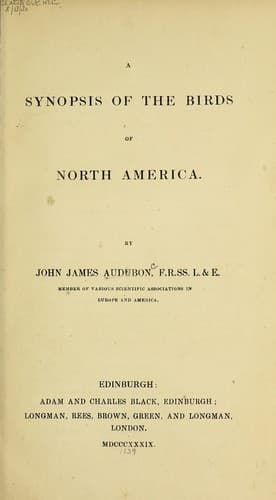
A Synopsis of the Birds of North AmericaAudubon, John James
Science
A Synopsis of the Birds of North America
Audubon, John James
Birds -- Classification; Birds -- North America
Bill about the same length as the head, rather slender,
brownish-black; feet reddish-brown; wings two inches longer than the
tail, which is merely emarginate; head, neck, breast, sides, and
abdomen, greyish-black; lower tail-coverts white, lower wing-coverts
bluish-grey; upper parts dark bluish-grey, the outer web of the first
quill greyish-black; shafts of quills and tail-feathers white. Young
in second plumage with the upper parts greyish-blue, the feathers of
the fore part of the back, and especially the scapulars, brown towards
the end; the upper and hind part of the head greyish-black, of which
there is a darker mark behind and another before the eye; forehead
greyish-white, as are the sides of the head, the fore neck, breast,
and abdomen; sides dusky grey; lower wing-coverts greyish-white.
_Adult_, 9, 24. _Young_, in autumn, 7-3/4; wing, 9-8/12.
Arrives in Texas from the south early in spring, proceeds along the
coast to the Mississippi, then ascends that river and its tributaries,
breeding around ponds, or along the streams; and even advances to the
Fur Countries, where it also breeds. Abundant. Migratory. Occasionally
along the coasts of the Middle Atlantic Districts.
Sterna nigra, Bonap. Syn. p. 355.
Sterna nigra, Black Tern, Swains. & Rich. F. Bor. Amer. v. ii.
p. 415.
Black Tern or Stern, Nutt. Man. v. ii. p. 282.
Black Tern, Sterna nigra, Aud. Orn. Biog. v. iii. p. 593; v.
v. p. 642.
439. 11. Sterna minuta, Linn. Least Tern.
Plate CCCXIX. Adult and Young.
Bill about the length of the head, slender, yellowish-orange, with the
tips black, but the extreme points horn-colour; feet light orange-red;
wings an inch or more longer than the tail, which is deeply forked; on
the forehead a triangular white patch, extending to over the middle of
the eye; upper part of head and nape, and loral space, deep black;
sides of head, fore neck, and lower parts pure white; back and wings
very pale bluish-grey; first two quills with the outer web
greyish-black, and rather less than half of their inner web of the
same colour, the rest white, extending to about half an inch from
their extremities; tail white in summer, of a paler tint than the back
at other times. Young, when fledged, with the bill greenish-black, all
the lower parts dull greyish-white, as are the upper, including the
tail, the hind part of the head streaked with dusky, on the back and
rump the feathers with a curved marginal band of greyish-brown;
primary quills greyish-brown, the outer two darker; tail even, each
feather narrowly margined with greyish-white.
_Adult_, 8-3/4, 18-3/4.
Breeds from Galveston along the shores to Labrador. Not mentioned as
found in the Fur Countries. Returns southward, and passes beyond Texas
in autumn. Extremely abundant at times on the Great Lakes, as well as
the Ohio and Mississippi.
Least Tern, Sterna minuta, Wils. Amer. Orn. v. vii. p. 80.
Sterna minuta, Bonap. Syn. p. 355.
Public-domain text, read in full here on John Shaqi.
Reviews
Reviews
No reviews yet
Be the first to share your thoughts on this work.
Elsewhere in the archive
Join the Discussion
Join the discussion
Sign in to leave a comment or review.
Sign InorCreate an account