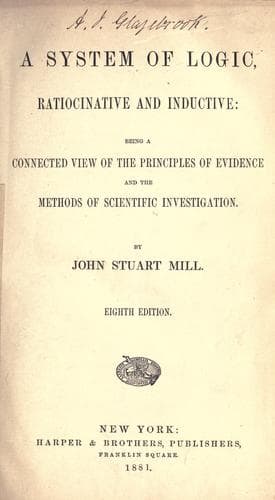
A System of Logic, Ratiocinative and InductiveMill, John Stuart
PhilosophyPhilosophy
A System of Logic, Ratiocinative and Inductive
Mill, John Stuart
Knowledge, Theory of; Logic; Science -- Methodology
In regard to such names of attributes as are connotative, and express
attributes of those attributes, there is no difficulty: like other
connotative names, they are defined by declaring their connotation. Thus
the word _fault_ may be defined, “a quality productive of evil or
inconvenience.” Sometimes, again, the attribute to be defined is not one
attribute, but a union of several: we have only, therefore, to put
together the names of all the attributes taken separately, and we obtain
the definition of the name which belongs to them all taken together; a
definition which will correspond exactly to that of the corresponding
concrete name. For, as we define a concrete name by enumerating the
attributes which it connotes, and as the attributes connoted by a concrete
name form the entire signification of the corresponding abstract name, the
same enumeration will serve for the definition of both. Thus, if the
definition of a _human being_ be this, “a being, corporeal, animated,
rational, shaped so and so,” the definition of _humanity_ will be
corporeity and animal life, combined with rationality, and with such and
such a shape.
When, on the other hand, the abstract name does not express a complication
of attributes, but a single attribute, we must remember that every
attribute is grounded on some fact or phenomenon, from which, and which
alone, it derives its meaning. To that fact or phenomenon, called in a
former chapter the foundation of the attribute, we must, therefore, have
recourse for its definition. Now, the foundation of the attribute may be a
phenomenon of any degree of complexity, consisting of many different
parts, either co-existent or in succession. To obtain a definition of the
attribute, we must analyze the phenomenon into these parts. Eloquence, for
example, is the name of one attribute only; but this attribute is grounded
on external effects of a complicated nature, flowing from acts of the
person to whom we ascribe the attribute; and by resolving this phenomenon
of causation into its two parts, the cause and the effect, we obtain a
definition of eloquence, viz. the power of influencing the feelings by
speech or writing.
Public-domain text, read in full here on John Shaqi.
Reviews
Reviews
No reviews yet
Be the first to share your thoughts on this work.
Elsewhere in the archive
Join the Discussion
Join the discussion
Sign in to leave a comment or review.
Sign InorCreate an account