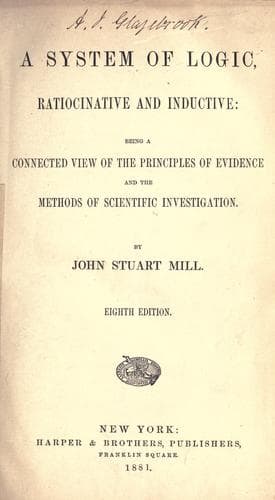
A System of Logic, Ratiocinative and InductiveMill, John Stuart
PhilosophyPhilosophy
A System of Logic, Ratiocinative and Inductive
Mill, John Stuart
Knowledge, Theory of; Logic; Science -- Methodology
Scientific definitions, whether they are definitions of scientific terms,
or of common terms used in a scientific sense, are almost always of the
kind last spoken of: their main purpose is to serve as the landmarks of
scientific classification. And since the classifications in any science
are continually modified as scientific knowledge advances, the definitions
in the sciences are also constantly varying. A striking instance is
afforded by the words Acid and Alkali, especially the former. As
experimental discovery advanced, the substances classed with acids have
been constantly multiplying, and by a natural consequence the attributes
connoted by the word have receded and become fewer. At first it connoted
the attributes, of combining with an alkali to form a neutral substance
(called a salt); being compounded of a base and oxygen; causticity to the
taste and touch; fluidity, etc. The true analysis of muriatic acid, into
chlorine and hydrogen, caused the second property, composition from a base
and oxygen, to be excluded from the connotation. The same discovery fixed
the attention of chemists upon hydrogen as an important element in acids;
and more recent discoveries having led to the recognition of its presence
in sulphuric, nitric, and many other acids, where its existence was not
previously suspected, there is now a tendency to include the presence of
this element in the connotation of the word. But carbonic acid, silica,
sulphurous acid, have no hydrogen in their composition; that property can
not, therefore, be connoted by the term, unless those substances are no
longer to be considered acids. Causticity and fluidity have long since
been excluded from the characteristics of the class, by the inclusion of
silica and many other substances in it; and the formation of neutral
bodies by combination with alkalis, together with such electro-chemical
peculiarities as this is supposed to imply, are now the only _differentiæ_
which form the fixed connotation of the word Acid, as a term of chemical
science.
What is true of the definition of any term of science, is of course true
of the definition of a science itself; and accordingly (as observed in the
Introductory Chapter of this work), the definition of a science must
necessarily be progressive and provisional. Any extension of knowledge or
alteration in the current opinions respecting the subject-matter, may lead
to a change more or less extensive in the particulars included in the
science; and its composition being thus altered, it may easily happen that
a different set of characteristics will be found better adapted as
differentiæ for defining its name.
Public-domain text, read in full here on John Shaqi.
Reviews
Reviews
No reviews yet
Be the first to share your thoughts on this work.
Elsewhere in the archive
Join the Discussion
Join the discussion
Sign in to leave a comment or review.
Sign InorCreate an account