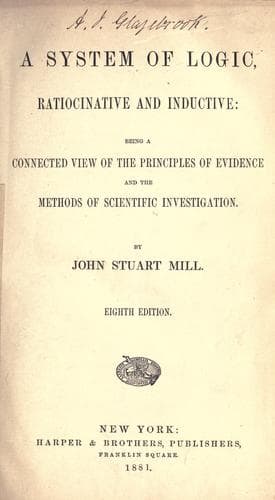
A System of Logic, Ratiocinative and InductiveMill, John Stuart
PhilosophyPhilosophy
A System of Logic, Ratiocinative and Inductive
Mill, John Stuart
Knowledge, Theory of; Logic; Science -- Methodology
a diagram any of the properties of the circle? Not that in all circles the
radii are equal, but only that they are so in the circle ABC. As our
warrant for assuming this, we appeal, it is true, to the definition of a
circle in general; but it is only necessary that the assumption be granted
in the case of the particular circle supposed. From this, which is not a
general but a singular proposition, combined with other propositions of a
similar kind, some of which _when generalized_ are called definitions, and
other axioms, we prove that a certain conclusion is true, not of all
circles, but of the particular circle ABC; or at least would be so, if the
facts precisely accorded with our assumptions. The enunciation, as it is
called, that is, the general theorem which stands at the head of the
demonstration, is not the proposition actually demonstrated. One instance
only is demonstrated: but the process by which this is done, is a process
which, when we consider its nature, we perceive might be exactly copied in
an indefinite number of other instances; in every instance which conforms
to certain conditions. The contrivance of general language furnishing us
with terms which connote these conditions, we are able to assert this
indefinite multitude of truths in a single expression, and this expression
is the general theorem. By dropping the use of diagrams, and substituting,
in the demonstrations, general phrases for the letters of the alphabet, we
might prove the general theorem directly, that is, we might demonstrate
all the cases at once; and to do this we must, of course, employ as our
premises, the axioms and definitions in their general form. But this only
means, that if we can prove an individual conclusion by assuming an
individual fact, then in whatever case we are warranted in making an
exactly similar assumption, we may draw an exactly similar conclusion. The
definition is a sort of notice to ourselves and others, what assumptions
we think ourselves entitled to make. And so in all cases, the general
propositions, whether called definitions, axioms, or laws of nature, which
we lay down at the beginning of our reasonings, are merely abridged
statements, in a kind of short-hand, of the particular facts, which, as
occasion arises, we either think we may proceed on as proved, or intend to
assume. In any one demonstration it is enough if we assume for a
particular case suitably selected, what by the statement of the definition
or principle we announce that we intend to assume in all cases which may
arise. The definition of the circle, therefore, is to one of Euclid’s
demonstrations, exactly what, according to Stewart, the axioms are; that
is, the demonstration does not depend on it, but yet if we deny it the
demonstration fails. The proof does not rest on the general assumption,
but on a similar assumption confined to the particular case: that case,
however, being chosen as a specimen or paradigm of the whole class of
Public-domain text, read in full here on John Shaqi.
Reviews
Reviews
No reviews yet
Be the first to share your thoughts on this work.
Elsewhere in the archive
Join the Discussion
Join the discussion
Sign in to leave a comment or review.
Sign InorCreate an account