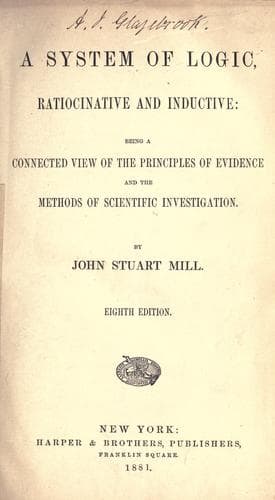
A System of Logic, Ratiocinative and InductiveMill, John Stuart
PhilosophyPhilosophy
A System of Logic, Ratiocinative and Inductive
Mill, John Stuart
Knowledge, Theory of; Logic; Science -- Methodology
Some additional remarks, in reply to minor objections, are appended.(65)
§ 9. The preceding considerations enable us to understand the true nature
of what is termed, by recent writers, Formal Logic, and the relation
between it and Logic in the widest sense. Logic, as I conceive it, is the
entire theory of the ascertainment of reasoned or inferred truth. Formal
Logic, therefore, which Sir William Hamilton from his own point of view,
and Archbishop Whately from his, have represented as the whole of Logic
properly so called, is really a very subordinate part of it, not being
directly concerned with the process of Reasoning or Inference in the sense
in which that process is a part of the Investigation of Truth. What, then,
is Formal Logic? The name seems to be properly applied to all that portion
of doctrine which relates to the equivalence of different modes of
expression; the rules for determining when assertions in a given form
imply or suppose the truth or falsity of other assertions. This includes
the theory of the Import of Propositions, and of their Conversion,
Æquipollence, and Opposition; of those falsely called Inductions (to be
hereafter spoken of)(66), in which the apparent generalization is a mere
abridged statement of cases known individually; and finally, of the
syllogism: while the theory of Naming, and of (what is inseparably
connected with it) Definition, though belonging still more to the other
and larger kind of logic than to this, is a necessary preliminary to this.
The end aimed at by Formal Logic, and attained by the observance of its
precepts, is not truth, but consistency. It has been seen that this is the
only direct purpose of the rules of the syllogism; the intention and
effect of which is simply to keep our inferences or conclusions in
complete consistency with our general formulæ or directions for drawing
them. The Logic of Consistency is a necessary auxiliary to the logic of
truth, not only because what is inconsistent with itself or with other
truths can not be true, but also because truth can only be successfully
pursued by drawing inferences from experience, which, if warrantable at
all, admit of being generalized, and, to test their warrantableness,
require to be exhibited in a generalized form; after which the correctness
of their application to particular cases is a question which specially
concerns the Logic of Consistency. This Logic, not requiring any
preliminary knowledge of the processes or conclusions of the various
sciences, may be studied with benefit in a much earlier stage of education
than the Logic of Truth: and the practice which has empirically obtained
of teaching it apart, through elementary treatises which do not attempt to
include any thing else, though the reasons assigned for the practice are
in general very far from philosophical, admits of philosophical
justification.
Chapter IV.
Of Trains Of Reasoning, And Deductive Sciences.
Public-domain text, read in full here on John Shaqi.
Reviews
Reviews
No reviews yet
Be the first to share your thoughts on this work.
Elsewhere in the archive
Join the Discussion
Join the discussion
Sign in to leave a comment or review.
Sign InorCreate an account