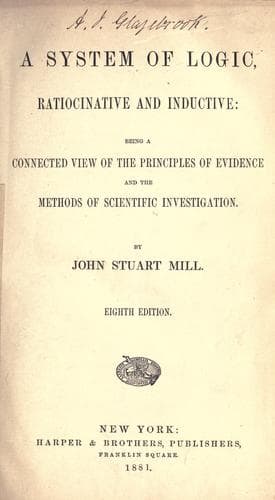
A System of Logic, Ratiocinative and InductiveMill, John Stuart
PhilosophyPhilosophy
A System of Logic, Ratiocinative and Inductive
Mill, John Stuart
Knowledge, Theory of; Logic; Science -- Methodology
may only be recognized through a third set of marks; and we may have a
train of reasoning, of any length, to bring a new case within the scope of
an induction grounded on particulars its similarity to which is only
ascertained in this indirect manner.
Thus, in the preceding example, the ultimate inductive inference was, that
a certain government was not likely to be overthrown; this inference was
drawn according to a formula in which desire of the public good was set
down as a mark of not being likely to be overthrown; a mark of this mark
was, acting in a particular manner; and a mark of acting in that manner
was, being asserted to do so by intelligent and disinterested witnesses:
this mark, the government under discussion was recognized by the senses as
possessing. Hence that government fell within the last induction, and by
it was brought within all the others. The perceived resemblance of the
case to one set of observed particular cases, brought it into known
resemblance with another set, and that with a third.
In the more complex branches of knowledge, the deductions seldom consist,
as in the examples hitherto exhibited, of a single chain, _a_ a mark of
_b, b_ of _c, c_ of _d_, therefore _a_ a mark of _d_. They consist (to
carry on the same metaphor) of several chains united at the extremity, as
thus: _a_ a mark of _d, b_ of _e, c_ of _f, d e f_ of _n_, therefore _a b
c_ a mark of _n_. Suppose, for example, the following combination of
circumstances: 1st, rays of light impinging on a reflecting surface; 2d,
that surface parabolic; 3d, those rays parallel to each other and to the
axis of the surface. It is to be proved that the concourse of these three
circumstances is a mark that the reflected rays will pass through the
focus of the parabolic surface. Now, each of the three circumstances is
singly a mark of something material to the case. Rays of light impinging
on a reflecting surface are a mark that those rays will be reflected at an
angle equal to the angle of incidence. The parabolic form of the surface,
is a mark that, from any point of it, a line drawn to the focus and a line
parallel to the axis will make equal angles with the surface. And finally,
the parallelism of the rays to the axis is a mark that their angle of
incidence coincides with one of these equal angles. The three marks taken
together are therefore a mark of all these three things united. But the
three united are evidently a mark that the angle of reflection must
coincide with the other of the two equal angles, that formed by a line
drawn to the focus; and this again, by the fundamental axiom concerning
straight lines, is a mark that the reflected rays pass through the focus.
Most chains of physical deduction are of this more complicated type; and
even in mathematics such are abundant, as in all propositions where the
hypothesis includes numerous conditions: “_If_ a circle be taken, and _if_
within that circle a point be taken, not the centre, and _if_ straight
Public-domain text, read in full here on John Shaqi.
Reviews
Reviews
No reviews yet
Be the first to share your thoughts on this work.
Elsewhere in the archive
Join the Discussion
Join the discussion
Sign in to leave a comment or review.
Sign InorCreate an account