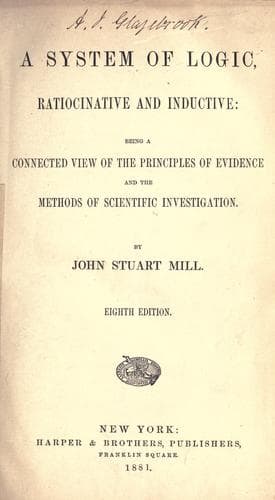
A System of Logic, Ratiocinative and InductiveMill, John Stuart
PhilosophyPhilosophy
A System of Logic, Ratiocinative and Inductive
Mill, John Stuart
Knowledge, Theory of; Logic; Science -- Methodology
§ 5. It will be seen hereafter(67) that there are weighty scientific
reasons for giving to every science as much of the character of a
Deductive Science as possible; for endeavoring to construct the science
from the fewest and the simplest possible inductions, and to make these,
by any combinations however complicated, suffice for proving even such
truths, relating to complex cases, as could be proved, if we chose, by
inductions from specific experience. Every branch of natural philosophy
was originally experimental; each generalization rested on a special
induction, and was derived from its own distinct set of observations and
experiments. From being sciences of pure experiment, as the phrase is, or,
to speak more correctly, sciences in which the reasonings mostly consist
of no more than one step, and are expressed by single syllogisms, all
these sciences have become to some extent, and some of them in nearly the
whole of their extent, sciences of pure reasoning; whereby multitudes of
truths, already known by induction from as many different sets of
experiments, have come to be exhibited as deductions or corollaries from
inductive propositions of a simpler and more universal character. Thus
mechanics, hydrostatics, optics, acoustics, thermology, have successively
been rendered mathematical; and astronomy was brought by Newton within the
laws of general mechanics. Why it is that the substitution of this
circuitous mode of proceeding for a process apparently much easier and
more natural, is held, and justly, to be the greatest triumph of the
investigation of nature, we are not, in this stage of our inquiry,
prepared to examine. But it is necessary to remark, that although, by this
progressive transformation, all sciences tend to become more and more
Deductive, they are not, therefore, the less Inductive; every step in the
Deduction is still an Induction. The opposition is not between the terms
Deductive and Inductive, but between Deductive and Experimental. A science
is experimental, in proportion as every new case, which presents any
peculiar features, stands in need of a new set of observations and
experiments—a fresh induction. It is deductive, in proportion as it can
draw conclusions, respecting cases of a new kind, by processes which bring
those cases under old inductions; by ascertaining that cases which can not
be observed to have the requisite marks, have, however, marks of those
marks.
Public-domain text, read in full here on John Shaqi.
Reviews
Reviews
No reviews yet
Be the first to share your thoughts on this work.
Elsewhere in the archive
Join the Discussion
Join the discussion
Sign in to leave a comment or review.
Sign InorCreate an account