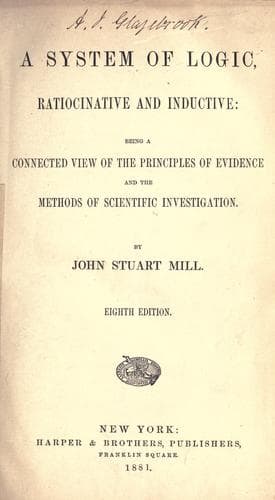
A System of Logic, Ratiocinative and InductiveMill, John Stuart
PhilosophyPhilosophy
A System of Logic, Ratiocinative and Inductive
Mill, John Stuart
Knowledge, Theory of; Logic; Science -- Methodology
It is not necessary to show that the truths which we call axioms are
originally _suggested_ by observation, and that we should never have known
that two straight lines can not inclose a space if we had never seen a
straight line: thus much being admitted by Dr. Whewell, and by all, in
recent times, who have taken his view of the subject. But they contend,
that it is not experience which _proves_ the axiom; but that its truth is
perceived _a priori_, by the constitution of the mind itself, from the
first moment when the meaning of the proposition is apprehended; and
without any necessity for verifying it by repeated trials, as is requisite
in the case of truths really ascertained by observation.
They can not, however, but allow that the truth of the axiom, Two straight
lines can not inclose a space, even if evident independently of
experience, is also evident from experience. Whether the axiom needs
confirmation or not, it receives confirmation in almost every instant of
our lives; since we can not look at any two straight lines which intersect
one another, without seeing that from that point they continue to diverge
more and more. Experimental proof crowds in upon us in such endless
profusion, and without one instance in which there can be even a suspicion
of an exception to the rule, that we should soon have stronger ground for
believing the axiom, even as an experimental truth, than we have for
almost any of the general truths which we confessedly learn from the
evidence of our senses. Independently of _a priori_ evidence, we should
certainly believe it with an intensity of conviction far greater than we
accord to any ordinary physical truth: and this too at a time of life much
earlier than that from which we date almost any part of our acquired
knowledge, and much too early to admit of our retaining any recollection
of the history of our intellectual operations at that period. Where then
is the necessity for assuming that our recognition of these truths has a
different origin from the rest of our knowledge, when its existence is
perfectly accounted for by supposing its origin to be the same? when the
causes which produce belief in all other instances, exist in this
instance, and in a degree of strength as much superior to what exists in
other cases, as the intensity of the belief itself is superior? The burden
of proof lies on the advocates of the contrary opinion: it is for them to
point out some fact, inconsistent with the supposition that this part of
our knowledge of nature is derived from the same sources as every other
part.(71)
Public-domain text, read in full here on John Shaqi.
Reviews
Reviews
No reviews yet
Be the first to share your thoughts on this work.
Elsewhere in the archive
Join the Discussion
Join the discussion
Sign in to leave a comment or review.
Sign InorCreate an account