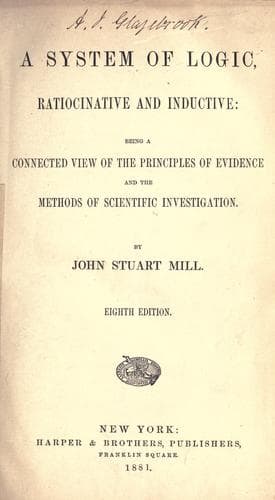
A System of Logic, Ratiocinative and InductiveMill, John Stuart
PhilosophyPhilosophy
A System of Logic, Ratiocinative and Inductive
Mill, John Stuart
Knowledge, Theory of; Logic; Science -- Methodology
applying at each step to _a_, _b_, and _x_, the proposition that equals
added to equals make equals; that equals taken from equals leave equals;
and other propositions founded on these two. These are not properties of
language, or of signs as such, but of magnitudes, which is as much as to
say, of all things. The inferences, therefore, which are successively
drawn, are inferences concerning things, not symbols; though as any Things
whatever will serve the turn, there is no necessity for keeping the idea
of the Thing at all distinct, and consequently the process of thought may,
in this case, be allowed without danger to do what all processes of
thought, when they have been performed often, will do if permitted,
namely, to become entirely mechanical. Hence the general language of
algebra comes to be used familiarly without exciting ideas, as all other
general language is prone to do from mere habit, though in no other case
than this can it be done with complete safety. But when we look back to
see from whence the probative force of the process is derived, we find
that at every single step, unless we suppose ourselves to be thinking and
talking of the things, and not the mere symbols, the evidence fails.
There is another circumstance, which, still more than that which we have
now mentioned, gives plausibility to the notion that the propositions of
arithmetic and algebra are merely verbal. That is, that when considered as
propositions respecting Things, they all have the appearance of being
identical propositions. The assertion, Two and one is equal to three,
considered as an assertion respecting objects, as for instance, “Two
pebbles and one pebble are equal to three pebbles,” does not affirm
equality between two collections of pebbles, but absolute identity. It
affirms that if we put one pebble to two pebbles, those very pebbles are
three. The objects, therefore, being the very same, and the mere assertion
that “objects are themselves” being insignificant, it seems but natural to
consider the proposition, Two and one is equal to three, as asserting mere
identity of signification between the two names.
Public-domain text, read in full here on John Shaqi.
Reviews
Reviews
No reviews yet
Be the first to share your thoughts on this work.
Elsewhere in the archive
Join the Discussion
Join the discussion
Sign in to leave a comment or review.
Sign InorCreate an account