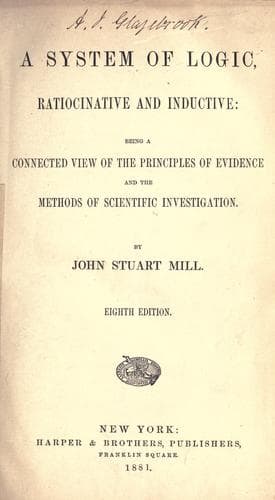
A System of Logic, Ratiocinative and InductiveMill, John Stuart
PhilosophyPhilosophy
A System of Logic, Ratiocinative and Inductive
Mill, John Stuart
Knowledge, Theory of; Logic; Science -- Methodology
The Science of Number is thus no exception to the conclusion we previously
arrived at, that the processes even of deductive sciences are altogether
inductive, and that their first principles are generalizations from
experience. It remains to be examined whether this science resembles
geometry in the further circumstance, that some of its inductions are not
exactly true; and that the peculiar certainty ascribed to it, on account
of which its propositions are called Necessary Truths, is fictitious and
hypothetical, being true in no other sense than that those propositions
legitimately follow from the hypothesis of the truth of premises which are
avowedly mere approximations to truth.
§ 3. The inductions of arithmetic are of two sorts: first, those which we
have just expounded, such as One and one are two, Two and one are three,
etc., which may be called the definitions of the various numbers, in the
improper or geometrical sense of the word Definition; and secondly, the
two following axioms: The sums of equals are equal, The differences of
equals are equal. These two are sufficient; for the corresponding
propositions respecting unequals may be proved from these by a _reductio
ad absurdum_.
These axioms, and likewise the so-called definitions, are, as has already
been said, results of induction; true of all objects whatever, and, as it
may seem, exactly true, without the hypothetical assumption of unqualified
truth where an approximation to it is all that exists. The conclusions,
therefore, it will naturally be inferred, are exactly true, and the
science of number is an exception to other demonstrative sciences in this,
that the categorical certainty which is predicable of its demonstrations
is independent of all hypothesis.
Public-domain text, read in full here on John Shaqi.
Reviews
Reviews
No reviews yet
Be the first to share your thoughts on this work.
Elsewhere in the archive
Join the Discussion
Join the discussion
Sign in to leave a comment or review.
Sign InorCreate an account