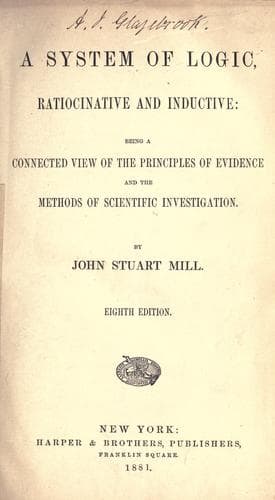
A System of Logic, Ratiocinative and InductiveMill, John Stuart
PhilosophyPhilosophy
A System of Logic, Ratiocinative and Inductive
Mill, John Stuart
Knowledge, Theory of; Logic; Science -- Methodology
§ 5. Sir William Hamilton holds as I do, that inconceivability is no
criterion of impossibility. “There is no ground for inferring a certain
fact to be impossible, merely from our inability to conceive its
possibility.” “Things there are which _may_, nay _must_, be true, of which
the understanding is wholly unable to construe to itself the
possibility.”(98) Sir William Hamilton is, however, a firm believer in the
_a priori_ character of many axioms, and of the sciences deduced from
them; and is so far from considering those axioms to rest on the evidence
of experience, that he declares certain of them to be true even of
Noumena—of the Unconditioned—of which it is one of the principal aims of
his philosophy to prove that the nature of our faculties debars us from
having any knowledge. The axioms to which he attributes this exceptional
emancipation from the limits which confine all our other possibilities of
knowledge; the chinks through which, as he represents, one ray of light
finds its way to us from behind the curtain which veils from us the
mysterious world of Things in themselves—are the two principles, which he
terms, after the school-men, the Principle of Contradiction, and the
Principle of Excluded Middle: the first, that two contradictory
propositions can not both be true; the second, that they can not both be
false. Armed with these logical weapons, we may boldly face Things in
themselves, and tender to them the double alternative, sure that they must
absolutely elect one or the other side, though we may be forever precluded
from discovering which. To take his favorite example, we can not conceive
the infinite divisibility of matter, and we can not conceive a minimum, or
end to divisibility: yet one or the other must be true.
As I have hitherto said nothing of the two axioms in question, those of
Contradiction and of Excluded Middle, it is not unseasonable to consider
them here. The former asserts that an affirmative proposition and the
corresponding negative proposition can not both be true; which has
generally been held to be intuitively evident. Sir William Hamilton and
the Germans consider it to be the statement in words of a form or law of
our thinking faculty. Other philosophers, not less deserving of
consideration, deem it to be an identical proposition; an assertion
involved in the meaning of terms; a mode of defining Negation, and the
word Not.
Public-domain text, read in full here on John Shaqi.
Reviews
Reviews
No reviews yet
Be the first to share your thoughts on this work.
Elsewhere in the archive
Join the Discussion
Join the discussion
Sign in to leave a comment or review.
Sign InorCreate an account