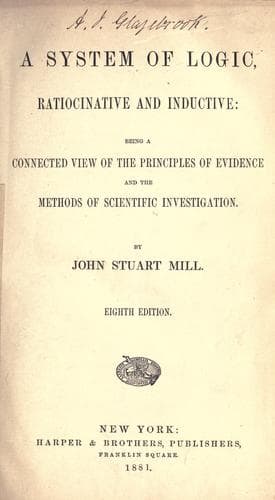
A System of Logic, Ratiocinative and InductiveMill, John Stuart
PhilosophyPhilosophy
A System of Logic, Ratiocinative and Inductive
Mill, John Stuart
Knowledge, Theory of; Logic; Science -- Methodology
§ 1. The portion of the present inquiry upon which we are now about to
enter, may be considered as the principal, both from its surpassing in
intricacy all the other branches, and because it relates to a process
which has been shown in the preceding Book to be that in which the
investigation of nature essentially consists. We have found that all
Inference, consequently all Proof, and all discovery of truths not
self-evident, consists of inductions, and the interpretation of
inductions: that all our knowledge, not intuitive, comes to us exclusively
from that source. What Induction is, therefore, and what conditions render
it legitimate, can not but be deemed the main question of the science of
logic—the question which includes all others. It is, however, one which
professed writers on logic have almost entirely passed over. The
generalities of the subject have not been altogether neglected by
metaphysicians; but, for want of sufficient acquaintance with the
processes by which science has actually succeeded in establishing general
truths, their analysis of the inductive operation, even when
unexceptionable as to correctness, has not been specific enough to be made
the foundation of practical rules, which might be for induction itself
what the rules of the syllogism are for the interpretation of induction:
while those by whom physical science has been carried to its present state
of improvement—and who, to arrive at a complete theory of the process,
needed only to generalize, and adapt to all varieties of problems, the
methods which they themselves employed in their habitual pursuits—never
until very lately made any serious attempt to philosophize on the subject,
nor regarded the mode in which they arrived at their conclusions as
deserving of study, independently of the conclusions themselves.
§ 2. For the purposes of the present inquiry, Induction may be defined,
the operation of discovering and proving general propositions. It is true
that (as already shown) the process of indirectly ascertaining individual
facts, is as truly inductive as that by which we establish general truths.
But it is not a different kind of induction; it is a form of the very same
process: since, on the one hand, generals are but collections of
particulars, definite in kind but indefinite in number; and on the other
hand, whenever the evidence which we derive from observation of known
cases justifies us in drawing an inference respecting even one unknown
case, we should on the same evidence be justified in drawing a similar
inference with respect to a whole class of cases. The inference either
does not hold at all, or it holds in all cases of a certain description;
in all cases which, in certain definable respects, resemble those we have
observed.
Public-domain text, read in full here on John Shaqi.
Reviews
Reviews
No reviews yet
Be the first to share your thoughts on this work.
Elsewhere in the archive
Join the Discussion
Join the discussion
Sign in to leave a comment or review.
Sign InorCreate an account