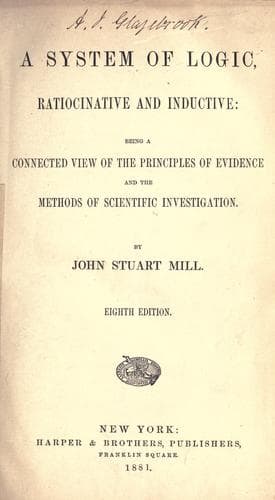
A System of Logic, Ratiocinative and InductiveMill, John Stuart
PhilosophyPhilosophy
A System of Logic, Ratiocinative and Inductive
Mill, John Stuart
Knowledge, Theory of; Logic; Science -- Methodology
a description of the phenomenon: if not, it was necessarily abandoned, and
another tried. It is such a case as this which gives rise to the doctrine
that the mind, in framing the descriptions, adds something of its own
which it does not find in the facts.
Yet it is a fact surely, that the planet does describe an ellipse; and a
fact which we could see, if we had adequate visual organs and a suitable
position. Not having these advantages, but possessing the conception of an
ellipse, or (to express the meaning in less technical language) knowing
what an ellipse was, Kepler tried whether the observed places of the
planet were consistent with such a path. He found they were so; and he,
consequently, asserted as a fact that the planet moved in an ellipse. But
this fact, which Kepler did not add to, but found in, the motions of the
planet, namely, that it occupied in succession the various points in the
circumference of a given ellipse, was the very fact, the separate parts of
which had been separately observed; it was the sum of the different
observations.
Having stated this fundamental difference between my opinion and that of
Dr. Whewell, I must add, that his account of the manner in which a
conception is selected, suitable to express the facts, appears to me
perfectly just. The experience of all thinkers will, I believe, testify
that the process is tentative; that it consists of a succession of
guesses; many being rejected, until one at last occurs fit to be chosen.
We know from Kepler himself that before hitting upon the “conception” of
an ellipse, he tried nineteen other imaginary paths, which, finding them
inconsistent with the observations, he was obliged to reject. But as Dr.
Whewell truly says, the successful hypothesis, though a guess, ought
generally to be called, not a lucky, but a skillful guess. The guesses
which serve to give mental unity and wholeness to a chaos of scattered
particulars, are accidents which rarely occur to any minds but those
abounding in knowledge and disciplined in intellectual combinations.
How far this tentative method, so indispensable as a means to the
colligation of facts for purposes of description, admits of application to
Induction itself, and what functions belong to it in that department, will
be considered in the chapter of the present Book which relates to
Hypotheses. On the present occasion we have chiefly to distinguish this
process of Colligation from Induction properly so called; and that the
distinction may be made clearer, it is well to advert to a curious and
interesting remark, which is as strikingly true of the former operation,
as it appears to me unequivocally false of the latter.
Public-domain text, read in full here on John Shaqi.
Reviews
Reviews
No reviews yet
Be the first to share your thoughts on this work.
Elsewhere in the archive
Join the Discussion
Join the discussion
Sign in to leave a comment or review.
Sign InorCreate an account