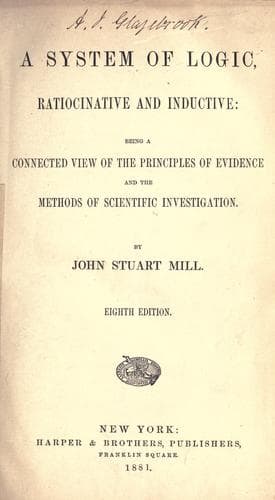
A System of Logic, Ratiocinative and InductiveMill, John Stuart
PhilosophyPhilosophy
A System of Logic, Ratiocinative and Inductive
Mill, John Stuart
Knowledge, Theory of; Logic; Science -- Methodology
Complex uniformities which, like this, are mere cases of simpler ones, and
have, therefore, been virtually affirmed in affirming those, may with
propriety be called _laws_, but can scarcely, in the strictness of
scientific speech, be termed Laws of Nature. It is the custom in science,
wherever regularity of any kind can be traced, to call the general
proposition which expresses the nature of that regularity, a law; as when,
in mathematics, we speak of the law of decrease of the successive terms of
a converging series. But the expression _law of nature_ has generally been
employed with a sort of tacit reference to the original sense of the word
law, namely, the expression of the will of a superior. When, therefore, it
appeared that any of the uniformities which were observed in nature, would
result spontaneously from certain other uniformities, no separate act of
creative will being supposed necessary for the production of the
derivative uniformities, these have not usually been spoken of as laws of
nature. According to one mode of expression, the question, What are the
laws of nature? may be stated thus: What are the fewest and simplest
assumptions, which being granted, the whole existing order of nature would
result? Another mode of stating it would be thus: What are the fewest
general propositions from which all the uniformities which exist in the
universe might be deductively inferred?
Every great advance which marks an epoch in the progress of science, has
consisted in a step made toward the solution of this problem. Even a
simple colligation of inductions already made, without any fresh extension
of the inductive inference, is already an advance in that direction. When
Kepler expressed the regularity which exists in the observed motions of
the heavenly bodies, by the three general propositions called his laws,
he, in so doing, pointed out three simple suppositions which, instead of a
much greater number, would suffice to construct the whole scheme of the
heavenly motions, so far as it was known up to that time. A similar and
still greater step was made when these laws, which at first did not seem
to be included in any more general truths, were discovered to be cases of
the three laws of motion, as obtaining among bodies which mutually tend
toward one another with a certain force, and have had a certain
instantaneous impulse originally impressed upon them. After this great
discovery, Kepler’s three propositions, though still called laws, would
hardly, by any person accustomed to use language with precision, be termed
laws of nature: that phrase would be reserved for the simpler and more
general laws into which Newton is said to have resolved them.
Public-domain text, read in full here on John Shaqi.
Reviews
Reviews
No reviews yet
Be the first to share your thoughts on this work.
Elsewhere in the archive
Join the Discussion
Join the discussion
Sign in to leave a comment or review.
Sign InorCreate an account