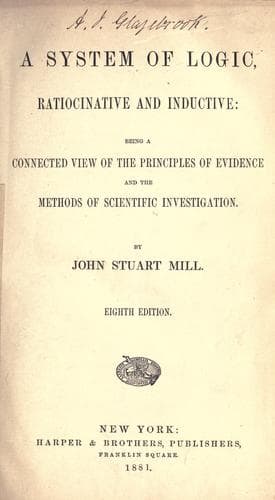
A System of Logic, Ratiocinative and InductiveMill, John Stuart
PhilosophyPhilosophy
A System of Logic, Ratiocinative and Inductive
Mill, John Stuart
Knowledge, Theory of; Logic; Science -- Methodology
of his catching cold; and though it might consist with usage to say that
the cause of his attack was exposure to the air, to be accurate we ought
to say that the cause was exposure to the air while under the effect of
mercury.
If we do not, when aiming at accuracy, enumerate all the conditions, it is
only because some of them will in most cases be understood without being
expressed, or because for the purpose in view they may without detriment
be overlooked. For example, when we say, the cause of a man’s death was
that his foot slipped in climbing a ladder, we omit as a thing unnecessary
to be stated the circumstance of his weight, though quite as indispensable
a condition of the effect which took place. When we say that the assent of
the crown to a bill makes it law, we mean that the assent, being never
given until all the other conditions are fulfilled, makes up the sum of
the conditions, though no one now regards it as the principal one. When
the decision of a legislative assembly has been determined by the casting
vote of the chairman, we sometimes say that this one person was the cause
of all the effects which resulted from the enactment. Yet we do not really
suppose that his single vote contributed more to the result than that of
any other person who voted in the affirmative; but, for the purpose we
have in view, which is to insist on his individual responsibility, the
part which any other person had in the transaction is not material.
In all these instances the fact which was dignified with the name of
cause, was the one condition which came last into existence. But it must
not be supposed that in the employment of the term this or any other rule
is always adhered to. Nothing can better show the absence of any
scientific ground for the distinction between the cause of a phenomenon
and its conditions, than the capricious manner in which we select from
among the conditions that which we choose to denominate the cause. However
numerous the conditions may be, there is hardly any of them which may not,
according to the purpose of our immediate discourse, obtain that nominal
pre-eminence. This will be seen by analyzing the conditions of some one
familiar phenomenon. For example, a stone thrown into water falls to the
bottom. What are the conditions of this event? In the first place there
must be a stone, and water, and the stone must be thrown into the water;
but these suppositions forming part of the enunciation of the phenomenon
itself, to include them also among the conditions would be a vicious
tautology; and this class of conditions, therefore, have never received
the name of cause from any but the Aristotelians, by whom they were called
the _material_ cause, _causa materialis_. The next condition is, there
must be an earth: and accordingly it is often said, that the fall of a
stone is caused by the earth; or by a power or property of the earth, or a
force exerted by the earth, all of which are merely roundabout ways of
Public-domain text, read in full here on John Shaqi.
Reviews
Reviews
No reviews yet
Be the first to share your thoughts on this work.
Elsewhere in the archive
Join the Discussion
Join the discussion
Sign in to leave a comment or review.
Sign InorCreate an account