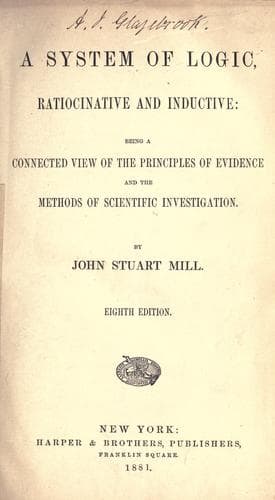
A System of Logic, Ratiocinative and InductiveMill, John Stuart
PhilosophyPhilosophy
A System of Logic, Ratiocinative and Inductive
Mill, John Stuart
Knowledge, Theory of; Logic; Science -- Methodology
may, in experience, have always been followed by another fact, yet if the
remainder of our experience teaches us that it might not always be so
followed, or if the experience itself is such as leaves room for a
possibility that the known cases may not correctly represent all possible
cases, the hitherto invariable antecedent is not accounted the cause; but
why? Because we are not sure that it _is_ the invariable antecedent.
Such cases of sequence as that of day and night not only do not contradict
the doctrine which resolves causation into invariable sequence, but are
necessarily implied in that doctrine. It is evident, that from a limited
number of unconditional sequences, there will result a much greater number
of conditional ones. Certain causes being given, that is, certain
antecedents which are unconditionally followed by certain consequents; the
mere co-existence of these causes will give rise to an unlimited number of
additional uniformities. If two causes exist together, the effects of both
will exist together; and if many causes co-exist, these causes (by what we
shall term hereafter the intermixture of their laws) will give rise to new
effects, accompanying or succeeding one another in some particular order,
which order will be invariable while the causes continue to co-exist, but
no longer. The motion of the earth in a given orbit round the sun, is a
series of changes which follow one another as antecedents and consequents,
and will continue to do so while the sun’s attraction, and the force with
which the earth tends to advance in a direct line through space, continue
to co-exist in the same quantities as at present. But vary either of these
causes, and this particular succession of motions would cease to take
place. The series of the earth’s motions, therefore, though a case of
sequence invariable within the limits of human experience, is not a case
of causation. It is not unconditional.
Public-domain text, read in full here on John Shaqi.
Reviews
Reviews
No reviews yet
Be the first to share your thoughts on this work.
Elsewhere in the archive
Join the Discussion
Join the discussion
Sign in to leave a comment or review.
Sign InorCreate an account