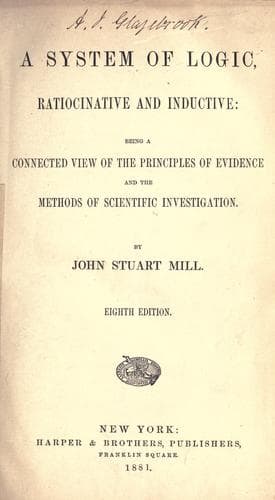
A System of Logic, Ratiocinative and InductiveMill, John Stuart
PhilosophyPhilosophy
A System of Logic, Ratiocinative and Inductive
Mill, John Stuart
Knowledge, Theory of; Logic; Science -- Methodology
In addition, however, to those attributes of a mind which are grounded on
its own states of feeling, attributes may also be ascribed to it, in the
same manner as to a body, grounded on the feelings which it excites in
other minds. A mind does not, indeed, like a body, excite sensations, but
it may excite thoughts or emotions. The most important example of
attributes ascribed on this ground, is the employment of terms expressive
of approbation or blame. When, for example, we say of any character, or
(in other words) of any mind, that it is admirable, we mean that the
contemplation of it excites the sentiment of admiration; and indeed
somewhat more, for the word implies that we not only feel admiration, but
approve that sentiment in ourselves. In some cases, under the semblance of
a single attribute, two are really predicated: one of them, a state of the
mind itself; the other, a state with which other minds are affected by
thinking of it. As when we say of any one that he is generous. The word
generosity expresses a certain state of mind, but being a term of praise,
it also expresses that this state of mind excites in us another mental
state, called approbation. The assertion made, therefore, is twofold, and
of the following purport: Certain feelings form habitually a part of this
person’s sentient existence; and the idea of those feelings of his,
excites the sentiment of approbation in ourselves or others.
As we thus ascribe attributes to minds on the ground of ideas and
emotions, so may we to bodies on similar grounds, and not solely on the
ground of sensations: as in speaking of the beauty of a statue; since this
attribute is grounded on the peculiar feeling of pleasure which the statue
produces in our minds; which is not a sensation, but an emotion.
VII. General Results.
§ 15. Our survey of the varieties of Things which have been, or which are
capable of being, named—which have been, or are capable of being, either
predicated of other Things, or themselves made the subject of
predications—is now concluded.
Our enumeration commenced with Feelings. These we scrupulously
distinguished from the objects which excite them, and from the organs by
which they are, or may be supposed to be, conveyed. Feelings are of four
sorts: Sensations, Thoughts, Emotions, and Volitions. What are called
Perceptions are merely a particular case of Belief, and Belief is a kind
of thought. Actions are merely volitions followed by an effect.
Public-domain text, read in full here on John Shaqi.
Reviews
Reviews
No reviews yet
Be the first to share your thoughts on this work.
Elsewhere in the archive
Join the Discussion
Join the discussion
Sign in to leave a comment or review.
Sign InorCreate an account