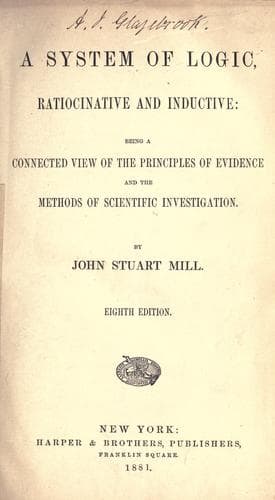
A System of Logic, Ratiocinative and InductiveMill, John Stuart
PhilosophyPhilosophy
A System of Logic, Ratiocinative and Inductive
Mill, John Stuart
Knowledge, Theory of; Logic; Science -- Methodology
After Feelings we proceeded to Substances. These are either Bodies or
Minds. Without entering into the grounds of the metaphysical doubts which
have been raised concerning the existence of Matter and Mind as objective
realities, we stated as sufficient for us the conclusion in which the best
thinkers are now for the most part agreed, that all we can know of Matter
is the sensations which it gives us, and the order of occurrence of those
sensations; and that while the substance Body is the unknown cause of our
sensations, the substance Mind is the unknown recipient.
The only remaining class of Namable Things is Attributes; and these are of
three kinds, Quality, Relation, and Quantity. Qualities, like substances,
are known to us no otherwise than by the sensations or other states of
consciousness which they excite: and while, in compliance with common
usage, we have continued to speak of them as a distinct class of Things,
we showed that in predicating them no one means to predicate any thing but
those sensations or states of consciousness, on which they may be said to
be grounded, and by which alone they can be defined or described.
Relations, except the simple cases of likeness and unlikeness, succession
and simultaneity, are similarly grounded on some fact or phenomenon, that
is, on some series of sensations or states of consciousness, more or less
complicated. The third species of Attribute, Quantity, is also manifestly
grounded on something in our sensations or states of feeling, since there
is an indubitable difference in the sensations excited by a larger and a
smaller bulk, or by a greater or a less degree of intensity, in any object
of sense or of consciousness. All attributes, therefore, are to us nothing
but either our sensations and other states of feeling, or something
inextricably involved therein; and to this even the peculiar and simple
relations just adverted to are not exceptions. Those peculiar relations,
however, are so important, and, even if they might in strictness be
classed among states of consciousness, are so fundamentally distinct from
any other of those states, that it would be a vain subtlety to bring them
under that common description, and it is necessary that they should be
classed apart.(24)
As the result, therefore, of our analysis, we obtain the following as an
enumeration and classification of all Namable Things:
1st. Feelings, or States of Consciousness.
2d. The Minds which experience those feelings.
3d. The Bodies, or external objects which excite certain of those
feelings, together with the powers or properties whereby they excite them;
these latter (at least) being included rather in compliance with common
opinion, and because their existence is taken for granted in the common
language from which I can not prudently deviate, than because the
recognition of such powers or properties as real existences appears to be
warranted by a sound philosophy.
Public-domain text, read in full here on John Shaqi.
Reviews
Reviews
No reviews yet
Be the first to share your thoughts on this work.
Elsewhere in the archive
Join the Discussion
Join the discussion
Sign in to leave a comment or review.
Sign InorCreate an account