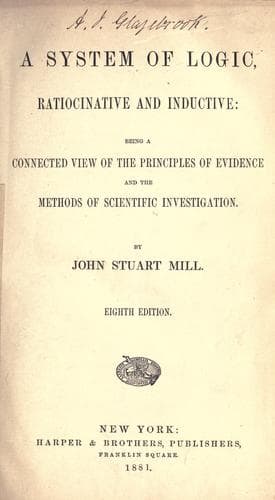
A System of Logic, Ratiocinative and InductiveMill, John Stuart
PhilosophyPhilosophy
A System of Logic, Ratiocinative and Inductive
Mill, John Stuart
Knowledge, Theory of; Logic; Science -- Methodology
§ 2. A proposition being a portion of discourse in which something is
affirmed or denied of something, the first division of propositions is
into affirmative and negative. An affirmative proposition is that in which
the predicate is _affirmed_ of the subject; as, Cæsar is dead. A negative
proposition is that in which the predicate is _denied_ of the subject; as,
Cæsar is not dead. The copula, in this last species of proposition,
consists of the words _is not_, which are the sign of negation; _is_ being
the sign of affirmation.
Some logicians, among whom may be mentioned Hobbes, state this distinction
differently; they recognize only one form of copula, _is_, and attach the
negative sign to the predicate. “Cæsar is dead,” and “Cæsar is not dead,”
according to these writers, are propositions agreeing not in the subject
and predicate, but in the subject only. They do not consider “dead,” but
“not dead,” to be the predicate of the second proposition, and they
accordingly define a negative proposition to be one in which the predicate
is a negative name. The point, though not of much practical moment,
deserves notice as an example (not unfrequent in logic) where by means of
an apparent simplification, but which is merely verbal, matters are made
more complex than before. The notion of these writers was, that they could
get rid of the distinction between affirming and denying, by treating
every case of denying as the affirming of a negative name. But what is
meant by a negative name? A name expressive of the _absence_ of an
attribute. So that when we affirm a negative name, what we are really
predicating is absence and not presence; we are asserting not that any
thing is, but that something is not; to express which operation no word
seems so proper as the word denying. The fundamental distinction is
between a fact and the non-existence of that fact; between seeing
something and not seeing it, between Cæsar’s being dead and his not being
dead; and if this were a merely verbal distinction, the generalization
which brings both within the same form of assertion would be a real
simplification: the distinction, however, being real, and in the facts, it
is the generalization confounding the distinction that is merely verbal;
and tends to obscure the subject, by treating the difference between two
kinds of truths as if it were only a difference between two kinds of
words. To put things together, and to put them or keep them asunder, will
remain different operations, whatever tricks we may play with language.
Public-domain text, read in full here on John Shaqi.
Reviews
Reviews
No reviews yet
Be the first to share your thoughts on this work.
Elsewhere in the archive
Join the Discussion
Join the discussion
Sign in to leave a comment or review.
Sign InorCreate an account