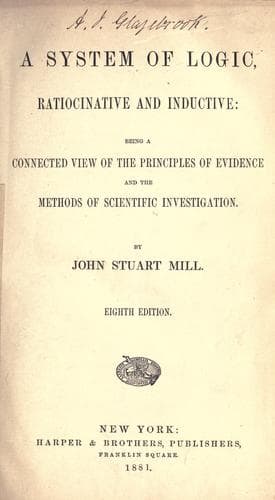
A System of Logic, Ratiocinative and InductiveMill, John Stuart
PhilosophyPhilosophy
A System of Logic, Ratiocinative and Inductive
Mill, John Stuart
Knowledge, Theory of; Logic; Science -- Methodology
Many volumes might be filled with the frivolous speculations concerning
the nature of Being (το ὄν, οὐσία, Ens, Entitas, Essentia, and the like),
which have arisen from overlooking this double meaning of the word _to
be_; from supposing that when it signifies _to exist_, and when it
signifies to _be_ some specified thing, as to _be_ a man, to _be_
Socrates, to _be_ seen or spoken of, to _be_ a phantom, even to _be_ a
nonentity, it must still, at bottom, answer to the same idea; and that a
meaning must be found for it which shall suit all these cases. The fog
which rose from this narrow spot diffused itself at an early period over
the whole surface of metaphysics. Yet it becomes us not to triumph over
the great intellects of Plato and Aristotle because we are now able to
preserve ourselves from many errors into which they, perhaps inevitably,
fell. The fire-teazer of a modern steam-engine produces by his exertions
far greater effects than Milo of Crotona could, but he is not therefore a
stronger man. The Greeks seldom knew any language but their own. This
rendered it far more difficult for them than it is for us, to acquire a
readiness in detecting ambiguities. One of the advantages of having
accurately studied a plurality of languages, especially of those languages
which eminent thinkers have used as the vehicle of their thoughts, is the
practical lesson we learn respecting the ambiguities of words, by finding
that the same word in one language corresponds, on different occasions, to
different words in another. When not thus exercised, even the strongest
understandings find it difficult to believe that things which have a
common name, have not in some respect or other a common nature; and often
expend much labor very unprofitably (as was frequently done by the two
philosophers just mentioned) in vain attempts to discover in what this
common nature consists. But, the habit once formed, intellects much
inferior are capable of detecting even ambiguities which are common to
many languages: and it is surprising that the one now under consideration,
though it exists in the modern languages as well as in the ancient, should
have been overlooked by almost all authors. The quantity of futile
speculation which had been caused by a misapprehension of the nature of
the copula, was hinted at by Hobbes; but Mr. James Mill(25) was, I
believe, the first who distinctly characterized the ambiguity, and pointed
out how many errors in the received systems of philosophy it has had to
answer for. It has, indeed, misled the moderns scarcely less than the
ancients, though their mistakes, because our understandings are not yet so
completely emancipated from their influence, do not appear equally
irrational.
We shall now briefly review the principal distinctions which exist among
propositions, and the technical terms most commonly in use to express
those distinctions.
Public-domain text, read in full here on John Shaqi.
Reviews
Reviews
No reviews yet
Be the first to share your thoughts on this work.
Elsewhere in the archive
Join the Discussion
Join the discussion
Sign in to leave a comment or review.
Sign InorCreate an account