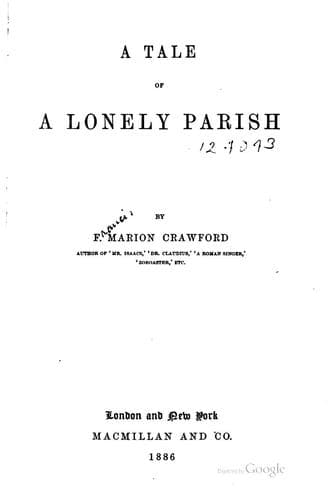
A Tale of a Lonely ParishCrawford, F. Marion (Francis Marion)
General
A Tale of a Lonely Parish
Crawford, F. Marion (Francis Marion)
Country life -- England -- Fiction; England -- Social life and customs -- Fiction
When Nellie came home from the vicarage she found her mother looking very
ill. There were dark rings under her eyes, and her features were drawn
and tear-stained, while the beautiful waves of her brown hair had lost
their habitual neatness and symmetry. The child noticed these things,
with a child's quickness, but explained them on the ground that her
mother's headache was probably much worse. Mrs. Goddard accepted the
explanation and on the following day Nellie had forgotten all about it;
but her mother remembered it long, and it was many days before she
recovered entirely from the shock of her interview with the squire. The
latter did not come to see her as usual, but on the morning after his
visit he sent her down a package of books and some orchids from his
hothouses. He thought it best to leave her to herself for a little while;
the very sight of him, he argued, would be painful to her, and any
meeting with her would be painful to himself. He did not go out of the
house, but spent the whole day in his library among his books, not indeed
reading, but pretending to himself that he was very busy. Being a strong
and sensible man he did not waste time in bemoaning his sorrows, but he
thought about them long and earnestly. The more he thought, the more it
appeared to him that Mrs. Goddard was the person who deserved pity rather
than he himself. His mind dwelt on the terrors of her position in case
her husband should return and claim his wife and daughter when the twelve
years were over, and he thought with horror of Nellie's humiliation, if
at the age of twenty she should discover that her father during all these
years had not been honourably dead and buried, but had been suffering the
punishment of a felon in Portland. That the only attempt he had ever made
to enter the matrimonial state should have been so singularly unfortunate
was indeed a matter which caused him sincere sorrow; he had thought too
often of being married to Mary Goddard to be able to give up the idea
without a sigh. But it is due to him to say that in the midst of his own
disappointment he thought much more of her sorrows than of his own, a
state of mind most probably due to his temperament.
Public-domain text, read in full here on John Shaqi.
Reviews
Reviews
No reviews yet
Be the first to share your thoughts on this work.
Elsewhere in the archive
Join the Discussion
Join the discussion
Sign in to leave a comment or review.
Sign InorCreate an account