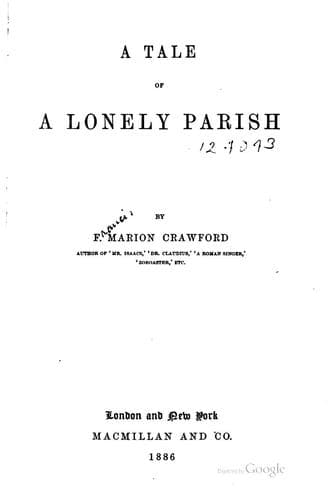
A Tale of a Lonely ParishCrawford, F. Marion (Francis Marion)
General
A Tale of a Lonely Parish
Crawford, F. Marion (Francis Marion)
Country life -- England -- Fiction; England -- Social life and customs -- Fiction
"Do you know him?" Goddard thought he detected a slight nervousness in
his wife's manner.
"Very well. This house belongs to him."
"Oh!" ejaculated the convict. "I begin to see."
"Yes--you see you had better go," said his wife innocently. "How can you
manage to come here tomorrow? You cannot go on without the money--"
"No--and I don't mean to," he answered roughly. Money was indeed an
absolute necessity to him. "Give me what you have got in the house,
anyhow. You may think better of it to-morrow. I don't trust people of
your stamp."
Mary Goddard rose without a word and left the room. When she was gone the
convict set himself to finish the jug of ale she had brought, and looked
about him. He saw objects that reminded him of his former home. He
examined the fork with which he had eaten and remembered the pattern and
the engraved initials as he turned it over in his hand. The very table
itself had belonged to his house--the carpet beneath his feet, the chair
upon which he sat. It all seemed too unnatural to be true. That very
night, that very hour, he must go forth again into the wild February
weather and hide himself, leaving all these things behind him; leaving
behind too his wife, the woman he had so bitterly injured, but who was
still his wife. It seemed impossible. Surely he might stay if he pleased;
it was not true that detectives were on his track--it was all a dream,
since that dreadful day when he had written that name, which was not his,
upon a piece of paper. He had waked up and was again at home. But he
started as he heard a footstep in the passage, being now accustomed to
start at sounds which suggested pursuit; he started and he felt the wet
smock-frock, which was his disguise, clinging to him as he moved, and the
reality of the present returned to him with awful force. His wife again
entered the room.
"There are over nine pounds," she said. "It is all I have." She laid the
money upon the table before him and remained standing. "You shall have
the rest to-morrow," she added.
"Can't I see Nellie?" he asked suddenly. It was the first time he had
spoken of his child. Mrs. Goddard hesitated.
"No," she said at last. "You cannot see her now. She must not be told;
she thinks you are dead. You may catch a glimpse of her to-morrow--"
"Well--it is better she should not know, I suppose. You could not
explain."
"No, Walter, I could not--explain. Come later to-morrow night--to the
same window. I will undo the shutters and give you the money." Mary
Goddard was almost overcome with exhaustion. It was a terrible struggle
to maintain her composure under such circumstances; but necessity does
wonders. "Where will you sleep to-night?" she asked presently. She pitied
the wretch from her heart, though she longed to see him leave her house.
Public-domain text, read in full here on John Shaqi.
Reviews
Reviews
No reviews yet
Be the first to share your thoughts on this work.
Elsewhere in the archive
Join the Discussion
Join the discussion
Sign in to leave a comment or review.
Sign InorCreate an account