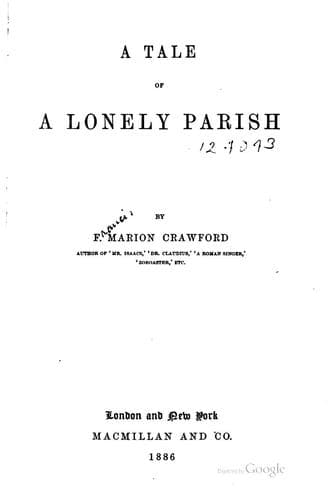
A Tale of a Lonely ParishCrawford, F. Marion (Francis Marion)
General
A Tale of a Lonely Parish
Crawford, F. Marion (Francis Marion)
Country life -- England -- Fiction; England -- Social life and customs -- Fiction
Mr. Juxon knew that he was right in putting the policeman off the track
in regard to Mrs. Goddard. He himself was a better detective than Gall,
for he went daily to the cottage and if anything was wrong there, was
quite sure to discover it. If Goddard ever made his way to Billingsfield
it could only be for the purpose of seeing his wife, and if he succeeded
in this, Mrs. Goddard could not conceal it from the squire. She was a
nervous woman who could not hide her emotions; she would find herself in
a terrible difficulty and she would perhaps turn to her friend for
assistance. If Mr. Juxon could lay his hands on Goddard, he flattered
himself he was much more able to arrest a desperate man than mild-eyed
Policeman Gall. He had not been at sea for thirty years in vain, and in
his time he had handled many a rough customer. He debated however upon
the course he should pursue. As in his opinion it was unlikely that
Goddard would find out his wife for some time, and improbable that he
would waste such precious time in looking for her, it seemed far from
advisable to warn her that the felon had escaped. On the other hand he
mistrusted his own judgment; if she were not prepared it was just
possible that the man should come upon her unawares, and the shock of
seeing him might be very much worse than the shock of being told that he
was at large. He might consult the vicar.
At first, the old feeling that it would be disloyal to Mrs. Goddard even
to hint to Mr. Ambrose that he was acquainted with her story withheld him
from pursuing such a course. But as he turned the matter over in his mind
it seemed to him that since it was directly for her good, he would now be
justified in speaking. He liked the vicar and he trusted him. He knew
that the vicar had been a good friend to Mrs. Goddard and that he would
stand by her in any difficulty so far as he might be able. The real
question was how to make sure that the vicar should not tell his wife. If
Mrs. Ambrose had the least suspicion that anything unusual was occurring,
she would naturally try and extract information from her husband, and she
would probably be successful; women, the squire thought, very generally
succeed in operations of that kind. But if once Mr. Ambrose could be
consulted without arousing his wife's suspicions, he was a man to be
trusted. Thereupon Mr. Juxon wrote a note to the vicar, saying that he
had something of great interest to show him, and begging that, if not
otherwise engaged, he would come up to the Hall to lunch. When he had
despatched his messenger, being a man of his word, he went into the
library to hunt for some rare volume or manuscript which the vicar had
not yet seen, and which might account in a spirit of rigid veracity for
the excuse he had given. Meanwhile, as he turned over his rare and
curious folios he debated further upon his conduct; but having once made
up his mind to consult Mr. Ambrose, he determined to tell him boldly what
Public-domain text, read in full here on John Shaqi.
Reviews
Reviews
No reviews yet
Be the first to share your thoughts on this work.
Elsewhere in the archive
Join the Discussion
Join the discussion
Sign in to leave a comment or review.
Sign InorCreate an account