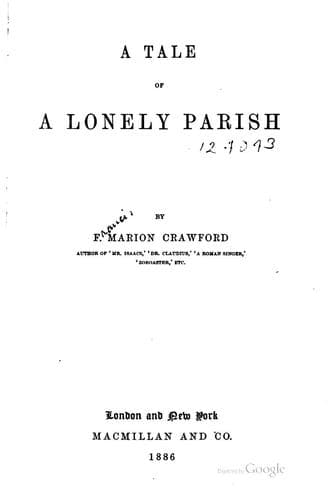
A Tale of a Lonely ParishCrawford, F. Marion (Francis Marion)
General
A Tale of a Lonely Parish
Crawford, F. Marion (Francis Marion)
Country life -- England -- Fiction; England -- Social life and customs -- Fiction
In a moment more he was gone, feeling that he had done his duty like a
man, and that it had not been so hard after all. He was glad it was done,
however, and he felt that he could face the vicar with a bold front at
their next meeting. He went quickly down the path and crossed the road to
his own gate with a light step. As he entered the park he was not aware
of a wretched-looking tramp who slouched along the quickset hedge and
watched his retreating figure far up the avenue, till he was out of sight
among the leafless trees. If Stamboul had been with the squire the tramp
would certainly not have passed unnoticed; but for some days the roads
had been so muddy that Stamboul had been left behind when Mr. Juxon made
his visits to the cottage, lest the great hound should track the mud into
the spotless precincts of the passage. The tramp stood still and looked
after the squire so long as he could see him, and then slunk off across
the wet meadows, where the standing water was now skimmed with ice.
Walter Goddard had spent the day in watching for the squire and he had
seen him at last. He had seen him go down the road with the vicar till
they were both out of sight, and he had seen him come back and enter the
cottage. This proceeding, he argued, betrayed that the squire did not
wish to be seen going into Mary's house by the vicar. The tortuous
intelligences of bad men easily impute to others courses which they
themselves would naturally pursue. Three words on the previous evening
had sufficed to rouse the convict's jealousy. What he saw to-day
confirmed his suspicions. The gentleman in knickerbockers could be no
other than the squire himself, of course. He was evidently in the habit
of visiting Mary Goddard and he did not wish his visits to be observed by
the clergyman, who was of course the vicar or rector of the parish. That
proved conclusively in the fugitive's mind that there was something
wrong. He ground his teeth together and said to himself that it would be
worth while to run some risk in order to stop that little game, as he
expressed it. He had, as he himself had confessed to his wife, murdered
one man in escaping; a man, he reflected, could only hang once, and if he
had not been taken in the streets of London he was not likely to be
caught in the high street of Billingsfield, Essex. It would be a great
satisfaction to knock the squire on the head before he went any farther.
Moreover he had found a wonderfully safe retreat in the disused vault at
the back of the church. He discovered loose stones inside the place which
he could pile up against the low hole which served for an entrance.
Probably no one knew that there was any entrance at all--the very
existence of the vault was most likely forgotten. It was not a cheerful
place, but Goddard's nerves were excited to a pitch far beyond the reach
of supernatural fears. Whatever he might be condemned to feel in the
future, his conscience troubled him very little in the present. The vault
Public-domain text, read in full here on John Shaqi.
Reviews
Reviews
No reviews yet
Be the first to share your thoughts on this work.
Elsewhere in the archive
Join the Discussion
Join the discussion
Sign in to leave a comment or review.
Sign InorCreate an account