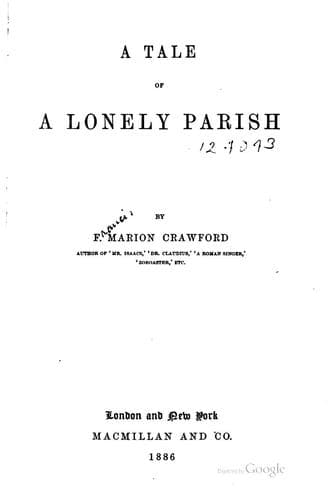
A Tale of a Lonely ParishCrawford, F. Marion (Francis Marion)
General
A Tale of a Lonely Parish
Crawford, F. Marion (Francis Marion)
Country life -- England -- Fiction; England -- Social life and customs -- Fiction
The inspiration was spontaneous. Mr. Juxon was in a frame of mind in
which he felt that he ought to do something pleasant for somebody, to set
off against the bloodthirsty designs which had passed through his mind in
the morning. He knew that if he had not been over friendly to John, it
had been John's own fault; but since he had found out that it was
impossible to marry Mrs. Goddard, he had forgiven the young scholar his
shortcomings and felt very charitably inclined towards him. It suddenly
struck him that it would give John great pleasure to stop at the Hall for
a few days, and that it would be no inconvenience to himself. The effect
upon Mrs. Ambrose was greater even than he had expected. She was
hospitable, good and kind, but she was also economical, as she had need
to be. The squire was rich. If the squire would put up John during a part
of his visit it would be a kindness to John himself, and an economy to
the vicarage. Mr. Ambrose himself would not have gone to such a length;
but then, as his wife said to herself in self-defence, Augustin did not
pay the butcher's bills, and did not know how the money went. She did not
say that Augustin was precisely what is called reckless, but he of course
did not understand economy as she did. How should he, poor man, with all
his sermons and his funerals and other occupations to take his mind off?
Mrs. Ambrose was delighted at the squire's proposal.
"Really!" she exclaimed. "That would be too good of you, Mr. Juxon. And
you do not know how it would quite delight him! He loves books so much,
and then you know," she added in a confidential manner, "he has never
stayed in a country house in his life, I am quite sure."
"And when is he coming down?" asked Mr. Juxon. "I should be very much
pleased to have him."
"To-morrow, I think," said Mrs. Ambrose.
"Well--would you ask him from me to come up and stop a week? Can you
spare him, Mrs. Ambrose? I know you are very fond of him, of course,
but--"
"Oh very," said she warmly. "But I think it likely he will stay some
time," she added in explanation of her willingness to let him go to the
Hall.
The squire felt vaguely that the presence of a guest in his house would
probably be a restraint upon him, and he felt that some restraint would
be agreeable to him at the present time.
"Besides," added Mrs. Ambrose, "if you would like to have him
first--there is a little repair necessary in his room at the vicarage--we
have put it off too long--"
"By all means." said the squire, following out his own train of thought.
"Send him up to me as soon as he comes. If I can manage it I will be down
here to ask him myself."
"It is so good of you," said Mrs. Ambrose.
"Not at all. Are you going to the cottage?"
"Yes--why?"
"Nothing," said Mr. Juxon. "I did not know whether you would like to walk
on a little farther with me. Good-bye, then. You will tell Short as soon
as he comes, will you not?"
Public-domain text, read in full here on John Shaqi.
Reviews
Reviews
No reviews yet
Be the first to share your thoughts on this work.
Elsewhere in the archive
Join the Discussion
Join the discussion
Sign in to leave a comment or review.
Sign InorCreate an account