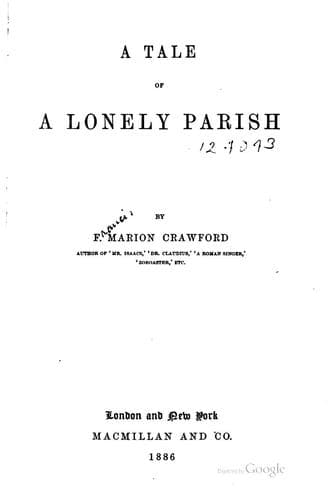
A Tale of a Lonely ParishCrawford, F. Marion (Francis Marion)
General
A Tale of a Lonely Parish
Crawford, F. Marion (Francis Marion)
Country life -- England -- Fiction; England -- Social life and customs -- Fiction
He stayed some hours at the vicarage. Both Mr. and Mrs. Ambrose thought
him changed in the short time which had elapsed since they had seen him.
He had grown more grave; he was certainly more of a man. The great
contest he had just sustained with so much honour had left upon his young
face its mark, an air of power which had not formerly been visible there;
even his voice seemed to have grown deeper and rounder, and his words
carried more weight. The good vicar, who had seen several generations
of students, already distinguished in John Short the budding "don," and
rubbed his hands with great satisfaction.
John asked few questions but found himself obliged to answer many
concerning his recent efforts. He would have liked to say something about
Mrs. Goddard, but he remembered with some awe and much aversion the
circumstances in which he had last quitted the vicarage, and he held his
peace; whereby he again rose in Mrs. Ambrose's estimation. He made up for
his silence by speaking effusively of the squire's kindness in asking him
to the Hall; forgetting perhaps the relief he had felt when he escaped
from Billingsfield after Christmas without being again obliged to shake
hands with Mr. Juxon. Things looked very differently now, however. He
felt himself to be somebody in the world, and that distressing sense of
inferiority which had perhaps been at the root of his jealousy against
the squire was gone, swallowed in the sense of triumph. His face was
pale, perhaps, from overwork, but there was a brilliancy in his eyes and
an incisiveness in his speech which came from the confidence of victory.
He now desired nothing more than to meet the squire, feeling sure that he
should receive his congratulations, and though he stayed some hours in
conversation with his old friends, in imagination he was already at the
Hall. The squire had not come down to meet him, as he had proposed, but
he had sent his outlandish American gig with his groom to fetch John.
While he was at the vicarage the latter was probably too much occupied
with conversation to notice that Mr. Ambrose seemed preoccupied and
changed, and the vicar was to some extent recalled to his usual manner by
the presence of his pupil. Mrs. Ambrose had taxed her husband with
concealing something from her ever since the previous day, but the good
man was obstinate and merely said that he felt unaccountably nervous and
irritable, and begged her to excuse his mood. Mrs. Ambrose postponed her
cross-examination until a more favourable opportunity should present
itself.
John got into the gig and drove away. He was to return with the squire to
dinner in the evening, and he fully expected that Mrs. Goddard and Nellie
would be of the party--it seemed hardly likely that they should be
omitted. Indeed, soon after John had left a note arrived at the vicarage
explaining that Mrs. Goddard was much better and would certainly come,
according to Mrs. Ambrose's very kind invitation.
Public-domain text, read in full here on John Shaqi.
Reviews
Reviews
No reviews yet
Be the first to share your thoughts on this work.
Elsewhere in the archive
Join the Discussion
Join the discussion
Sign in to leave a comment or review.
Sign InorCreate an account