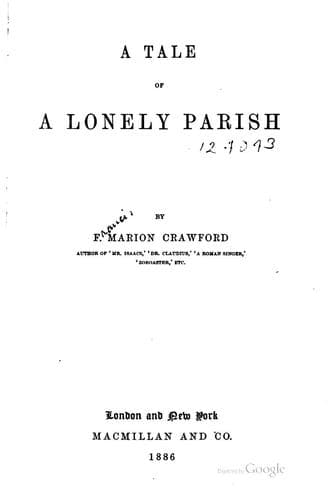
A Tale of a Lonely ParishCrawford, F. Marion (Francis Marion)
General
A Tale of a Lonely Parish
Crawford, F. Marion (Francis Marion)
Country life -- England -- Fiction; England -- Social life and customs -- Fiction
"Headache, I believe," returned the squire laconically, and silence
ensued for a few moments. "I should not wonder if it rained again this
evening," he added presently as they passed through the park gate, out
into the road. The sky was black and it was hard to see anything beyond
the yellow streak of light which fell from the lamps and ran along the
road before the gig.
"If it turns out a fine night, don't come for us. We will walk home,"
said the squire to the groom as they descended before the vicarage and
Stamboul, who had sat on the floor between them, sprang down to the
ground.
John was startled when he met Mrs. Goddard. He was amazed at the change
in her appearance for which no one had prepared him. She met him indeed
very cordially but he felt as though she were not the same woman he had
known so short a time before. There was still in her face that delicate
pathetic expression which had at first charmed him, there was still the
same look in her eyes; but what had formerly seemed so attractive seemed
now exaggerated. Her cheeks looked wan and hollow and there were deep
shadows about her eyes and temples; her lips had lost their colour and
the lines about her mouth had suddenly become apparent where John had not
before suspected them. She looked ten years older as she put her thin
hand in his and smiled pleasantly at his greeting. Some trite phrase
about the "ravages of time" crossed John's mind and gave him a
disagreeable sensation, for which it was hard to account. He felt as
though his dream were suddenly dead and a strange reality had taken life
in its place. Could this be she to whom he had written verses by the
score, at whose smile he had swelled with pride, at whose careless laugh
he had trembled with shame? She was terribly changed, she looked
positively old--what John called old. As he sat by her side talking and
wondering whether he would fall back into those same grooves of
conversation he had associated with her formerly, he felt something akin
to pity for her, which he had certainly never expected to feel. She was
not the same as before--even the tone of her voice was different; she was
gentle, pathetic, endowed even now with many charms, but she was not
the woman he had dreamed of and tried to speak to of the love he fancied
was in his heart. She talked--yes; but there were long pauses, and her
eyes wandered strangely from him, often towards the windows of the
vicarage drawing-room, often towards the doors; her answers were not
always to the point and her interest seemed to flag in what was said.
John could not fail to notice too that both Mr. Ambrose and Mr. Juxon
treated her with the kind of attention which is bestowed upon invalids,
and the vicar's wife was constantly doing something to make her
comfortable, offering her a footstool, shading the light from her eyes,
asking if she felt any draught where she sat. These were things no one
had formerly thought of doing for Mrs. Goddard, who in spite of her sad
Public-domain text, read in full here on John Shaqi.
Reviews
Reviews
No reviews yet
Be the first to share your thoughts on this work.
Elsewhere in the archive
Join the Discussion
Join the discussion
Sign in to leave a comment or review.
Sign InorCreate an account