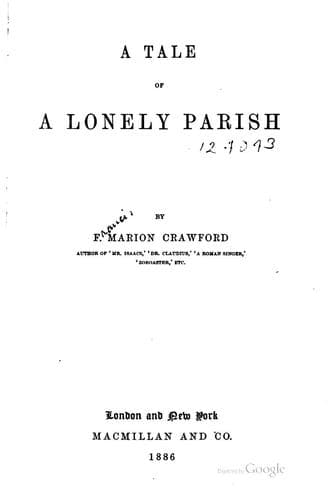
A Tale of a Lonely ParishCrawford, F. Marion (Francis Marion)
General
A Tale of a Lonely Parish
Crawford, F. Marion (Francis Marion)
Country life -- England -- Fiction; England -- Social life and customs -- Fiction
But when he was gone, Mrs. Goddard grew very nervous. One of her wraps
could not be found, and while search was being made for it the motherly
Mrs. Ambrose insisted upon giving her something hot, in the way of brandy
and water. She looked very ill, but showed the strongest desire to go. It
was no matter about the shawl, she said; Mr. Ambrose could send it in the
morning; but the thing was found and at last Mrs. Goddard and Nellie and
John got into the dog-cart with old Reynolds and drove off. All these
things consumed some time.
The squire on the other hand strode briskly forward towards the cottage,
not wishing to keep John waiting for him. As he walked his mind wandered
back to the consideration of the almost tragic events which were
occurring in the peaceful village. He forgot all about John, as he looked
up at the half moon which struggled to give some light through the
driving clouds; he fell to thinking of Mrs. Goddard and to wondering
where her husband might be lying hidden. The road was lonely and he
walked fast, with Stamboul close at his heel. The dog-cart did not
overtake him before he reached the cottage, and he forgot all about it.
By sheer force of habit he opened the white gate and, closing it behind
him, entered the park alone.
CHAPTER XIX.
John's impression of Mrs. Goddard was strengthened by the scene at the
vicarage at the moment of leaving. The extraordinary nervousness she
betrayed, the anxiety for her welfare shown by Mrs. Ambrose and the grave
face of the vicar all favoured the idea that she had become an invalid
since he had last met her. He himself fell into the manner of those about
him and spoke in low tones and moved delicately as though fearing to
offend her sensitive nerves. The vicar alone understood the situation and
had been very much surprised at the squire's sudden determination to walk
home; he would gladly have seized his hat and run after his friend, but
he feared Mrs. Ambrose's curiosity and moreover on reflection felt sure
that the dog-cart would overtake Mr. Juxon before he was half way to the
cottage. He was very far from suspecting him of the absence of mind which
he actually displayed, but it was a great relief to him to see the little
party safe in the dog-cart and on the way homeward.
Mrs. Goddard was on the front seat with old Reynolds, and John, who would
have preferred to sit by her side a few months ago, was glad to find
himself behind with Nellie. It was a curious instinct, but he felt it
strongly and was almost grateful to the old man for stolidly keeping his
seat. So he sat beside Nellie and talked to her, to the child's intense
delight; she had not enjoyed the evening very much, for she felt the
general sense of oppression as keenly as children always feel such
things, and she had long exhausted the slender stock of illustrated books
which lay upon the table in the vicarage drawing-room.
"There is no more skating now," said John. "What do you do to amuse
yourselves?"
Public-domain text, read in full here on John Shaqi.
Reviews
Reviews
No reviews yet
Be the first to share your thoughts on this work.
Elsewhere in the archive
Join the Discussion
Join the discussion
Sign in to leave a comment or review.
Sign InorCreate an account