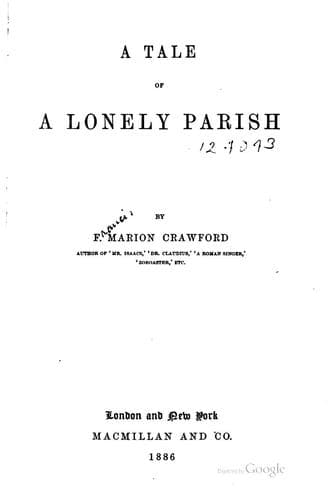
A Tale of a Lonely ParishCrawford, F. Marion (Francis Marion)
General
A Tale of a Lonely Parish
Crawford, F. Marion (Francis Marion)
Country life -- England -- Fiction; England -- Social life and customs -- Fiction
Yet there was something very generous and large-hearted in the way
Charles Juxon did his duty by the sick man. There are people who seem by
nature designed to act heroic parts in life, whose actions habitually
take an heroic form, and whose whole character is of another stamp from
that of average humanity. Of such people much is expected, because they
seem to offer much; no one is surprised to hear of their making great
sacrifices, no one is astonished if they exhibit great personal courage
in times of danger. Very often they are people of large vanity, whose
chiefest vanity is not to seem vain; gifted with great powers and always
seeking opportunities of using them, holding high ideas upon most
subjects but rarely conceiving themselves incapable of attaining to any
ideal they select for their admiration; brave in combat partly from real
courage, partly, as I have often heard officers say of a dandy soldier in
the ranks, because they are too proud to run away; but, on the whole,
heroic by temperament and in virtue of a singular compound of pride,
strength and virtue, often accomplishing really great things. They are
almost always what are called striking people, for their pride and their
strength generally attract attention by their magnitude, and something in
their mere appearance distinguishes them from the average mass.
But Charles Juxon did not in any way belong to this type, any more than
the other persons who found themselves concerned in the events which
culminated in Goddard's illness. He was a very simple man whose pride was
wholly unconscious, who did not believe himself destined to do anything
remarkable, who regarded his own personality as rather uninteresting and
who, had he been asked about himself, would have been the first to
disclaim any sentiments of the heroic kind. With very little imagination,
he possessed great stability himself and great belief in the stability of
things in general, a character of the traditional kind known as
"northern," though it would be much more just to describe it as the
"temperate" or "central" type of man. Wherever there is exaggeration in
nature, there is exaggerated imagination in man. The solid and
unimaginative part of the English character is undeniably derived from
the Angles or from the Flemish; it is morally the best part, but it is by
all odds the least interesting--it is found in the type of man belonging
to the plains in a temperate zone, who differs in every respect from the
real northman, his distant cousin and hereditary enemy. If Charles Juxon
was remarkable for anything it was for his modesty and reticence, in a
word, for his apparent determination not to be remarkable at all.
Public-domain text, read in full here on John Shaqi.
Reviews
Reviews
No reviews yet
Be the first to share your thoughts on this work.
Elsewhere in the archive
Join the Discussion
Join the discussion
Sign in to leave a comment or review.
Sign InorCreate an account