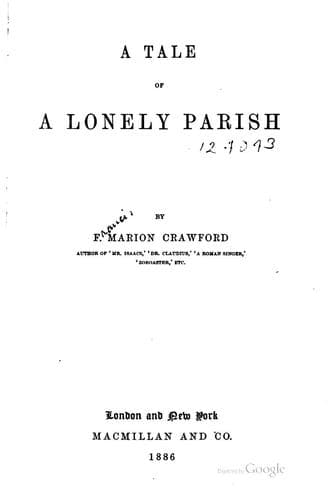
A Tale of a Lonely ParishCrawford, F. Marion (Francis Marion)
General
A Tale of a Lonely Parish
Crawford, F. Marion (Francis Marion)
Country life -- England -- Fiction; England -- Social life and customs -- Fiction
Again his eyes fixed themselves and the moaning began and continued. John
was horror-struck and stood for a moment gazing at his face, over which
the deep flush had spread once more, seeming to obliterate all appearance
of intelligence. Then the young man put his hand beneath Goddard's head
and gently replaced him in his former position, smoothing the pillows,
and giving him a little brandy. He debated whether or not he should call
the squire from his rest to tell him what had happened, but seeing that
Goddard had now returned to his former state, he supposed such moments of
clear speech were to be expected from time to time. He sat down again,
and waited; then after a time he went to the window and looked anxiously
for the dawn. It seemed an intolerably long night.
But the day came at last and shed a ghastly grey tinge upon the
sick-room, revealing as it were the outlines of all that was bad to look
at, which the warm yellow candle-light had softened with a kindlier
touch. John accidentally looked at himself in the mirror as he passed and
was startled at his own pale face; but the convict, labouring in the
ravings of his fever, seemed unconscious of the dawning day; he was not
yet exhausted and his harsh voice never ceased its jarring gibber. John
wondered whether he should ever spend such a night again, and shuddered
at the recollection of each moment.
The daylight waked the squire from his slumbers, however, and before the
sun was up he came out of the dressing-room, looking almost as fresh as
though nothing had happened to him in the night. Accustomed for years to
rise at all hours, in all weathers, unimpressionable, calm and strong, he
seemed superior to the course of events.
"Well, Mr. Short, you allowed me a long nap. You must be quite worn out,
I should think. How is the patient?"
John told what had occurred.
"Took you for the hangman, did he?" said the squire. "I wonder why--but
you say he asked after me very sensibly?"
"Quite so. It was when I asked him his own name, that he began raving
again," answered John innocently.
"What made you ask him that?" asked Mr. Juxon, who did not seem pleased.
"Curiosity," was John's laconic answer.
"Yes--but I fancy it frightened him. If I were you I would not do it
again, if he has a lucid moment. I imagine it was fright that made him
delirious in the first instance."
"All right," quoth John. "I won't." But he made his own deductions. The
squire evidently knew who he was, and did not want John to know, for some
unexplained reason. The young man wondered what the reason could be; the
mere name of the wretched man was not likely to convey any idea to his
mind, for it was highly improbable that he had ever met him before his
conviction. So John departed to his own room and refreshed himself with
a tub, while the squire kept watch by daylight.
It was not yet eight o'clock when Holmes brought a note from the vicar,
which Mr. Juxon tore open and read with anxious interest.
Public-domain text, read in full here on John Shaqi.
Reviews
Reviews
No reviews yet
Be the first to share your thoughts on this work.
Elsewhere in the archive
Join the Discussion
Join the discussion
Sign in to leave a comment or review.
Sign InorCreate an account