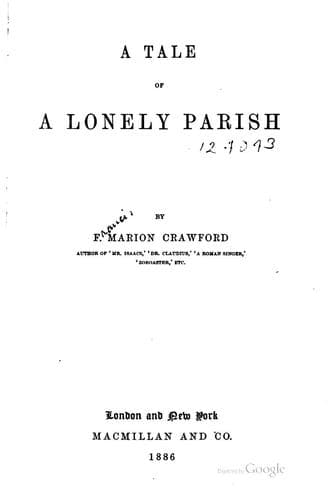
A Tale of a Lonely ParishCrawford, F. Marion (Francis Marion)
General
A Tale of a Lonely Parish
Crawford, F. Marion (Francis Marion)
Country life -- England -- Fiction; England -- Social life and customs -- Fiction
At the turn of the avenue he paused, at the spot where Goddard had
attacked him. There was nothing to be seen at first, for the road was
hard and dry and there was no trace of the scuffle; but as the squire
looked about he spied his hat, lying in the ditch, and picked it up. It
was heavy with the morning dew and the brim was broken and bent where
Goddard's weapon had struck it. Hard by in a heap of driven oak leaves
lay the weapon itself, which Mr. Juxon examined curiously. It was a
heavy piece of hewn oak, evidently very old, and at one end a thick iron
spike was driven through, the sharp point projecting upon one side and
the wrought head upon the other. He turned it over in his hands and
realised that he had narrowly escaped his death. Then he laid the hat and
the club together and threw a handful of leaves over them, intending to
take them to the Hall at a later hour, and he turned to go upon his way
towards the cottage. But as he turned he saw two men coming towards him,
and now not twenty yards away. His heart sank, for one of the two was
Thomas Gall the village constable; the other was a quiet-looking
individual with grey whiskers, plainly dressed and unassuming in
appearance. Instinctively the squire knew that Gall's companion must be a
detective. He was startled, and taken altogether unawares; but the men
were close upon him and there was nothing to be done but to face them
boldly.
Gall made his usual half military salute as he came up, and the man in
plain clothes raised his hat politely.
"The gentleman from Lunnon, sir," said Gall by way of introduction,
assuming an air of mysterious importance.
"Yes?" said Mr. Juxon interrogatively. "Do you wish to speak to me?"
"The gentleman's come on business, sir. In point of fact, sir, it's the
case we was speakin' of lately."
The squire knew very well what was the matter. Indeed, he had wondered
that the detective had not arrived sooner. That did not make it any
easier to receive him, however; on the contrary, if he had come on the
previous day matters would have been much simpler.
"Very well, Gall," answered Mr. Juxon. "I am much obliged to you for
bringing Mr.--" he paused and looked at the man in plain clothes.
"Booley, sir," said the detective.
"Thank you--yes--for bringing Mr. Booley so far. You may go home, Gall.
If we need your services we will send to your house."
"It struck me, sir," remarked Gall with a bland smile, "as perhaps I
might be of use--prefeshnal in fact, sir."
"I will send for you," said the detective, shortly. The manners of the
rural constabulary had long ceased to amuse him.
Gall departed rather reluctantly, but to make up for being left out of
the confidential interview which was to follow, he passed his thumb round
his belt and thrust out his portly chest as he marched down the avenue.
He subsequently spoke very roughly to a little boy who was driving an old
sheep to the butcher's at the other end of the village.
Public-domain text, read in full here on John Shaqi.
Reviews
Reviews
No reviews yet
Be the first to share your thoughts on this work.
Elsewhere in the archive
Join the Discussion
Join the discussion
Sign in to leave a comment or review.
Sign InorCreate an account